Shifting, Too Anxious to Be Fully Aware by Jonathan Yungkans

ralph-spegel-uzbgq0WdgPQ-unsplash

Shifting, Too Anxious to Be Fully Aware
by Jonathan Yungkans
           after John Ashbery

What could I say of a young Polish woman that January?
I was barely a year into college, on my first time abroad,

felt out of my depth. She worked the hotel dining room,
met me for coffee to practice English. My words faltered.

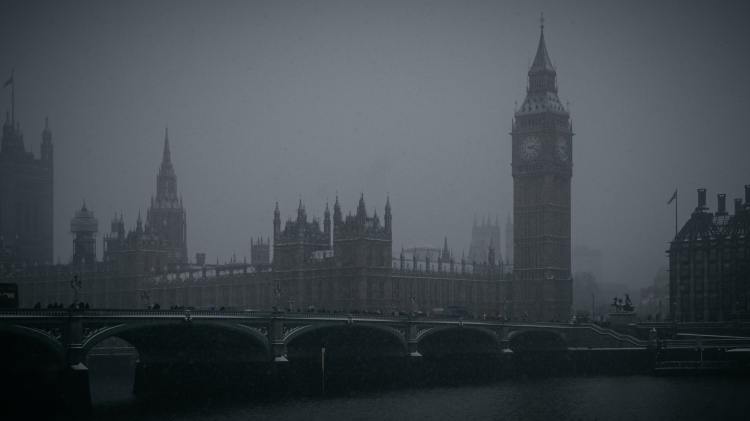
What could I say about watching London snow, first time
in 33 years, orange juice cartons cooling on a window sill,

drivers skidding white roads gray? Not about the Jameson’s
I downed in Windsor—the morning a chilled side of beef,

and me feeling hung on a freezer hook. After it, I reeled
a good part of the afternoon but stayed warm. Didn’t tell

a soul about Stratford-upon-Avon, where two Bobbies
tailed me—streets empty, shop windows dark, me feeling

the bottle of red wine drunk with dinner and deathly afraid
of a tourist trip of jail. Didn’t mention the trip to Wales—

hung over, I yearned for a deluge long as five summers
to wash Wordsworth and Tintern Abbey down a mountain

brook. As if nouns were stones, torn from cathedral walls
to drop and envelop me—a collapse followed by stillness.

Previously published in Panoply, a Literary Zine

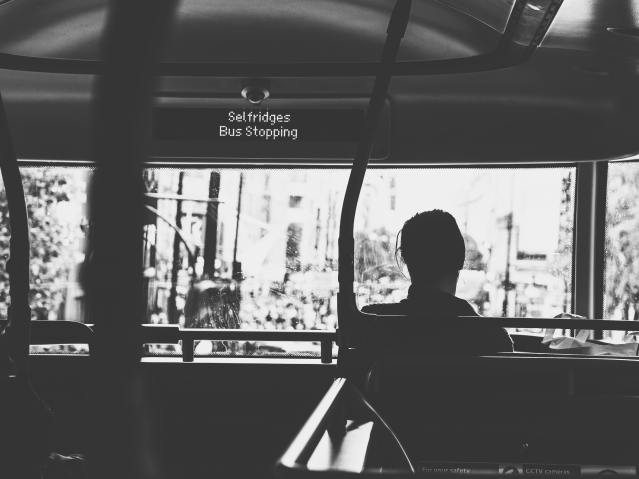
PHOTO: Winter, London, United Kingdom. Photo by Ralph Spegel on Unsplash

filippo-andolfatto-Hb3CRliKPP4-unsplash

NOTE FROM THE AUTHOR:  In 1980, I traveled to Britain as part of an undergraduate group. The poem is a series of highlights, rather than about a specific place—the travelogue of a stranger trying to make heads or tails of himself in a strange land.

PHOTO: Oxford Street, London, United Kingdom. Photo by Filippo Andolfatto on Unsplash

yungkans_author_pic

ABOUT THE AUTHOR: Jonathan Yungkans is a Los Angeles-based writer and photographer with an MFA from California State University, Long Beach. His work has appeared in San Pedro Poetry Review, SynkronicitiWest Texas Literary Review, and other publications. His second poetry chapbook, Beneath a Glazed Shimmer, won the 2019 Clockwise Chapbook Prize and is slated for release by Tebot Bach Publishing in 2020.

Semuc Champey by Lorraine Caputo

Guatemala scott walmsley licensed

Semuc Champey
by Lorraine Caputo

The frothing river tumbles
over boulders       through
crevasses

before it disappears
under the rock bridge
spanning this gorge

From the limestone cliffs
jungle cascades down
to the water’s edge

Streams wend through its growth
to fill         & fall pool
to deep turquoise pool
atop the bridge

The four-hundred-voice song of flocks
of zenzotles fills the
humid air

& when that river emerges
from the other tunnel       it is
a calmer whitewater

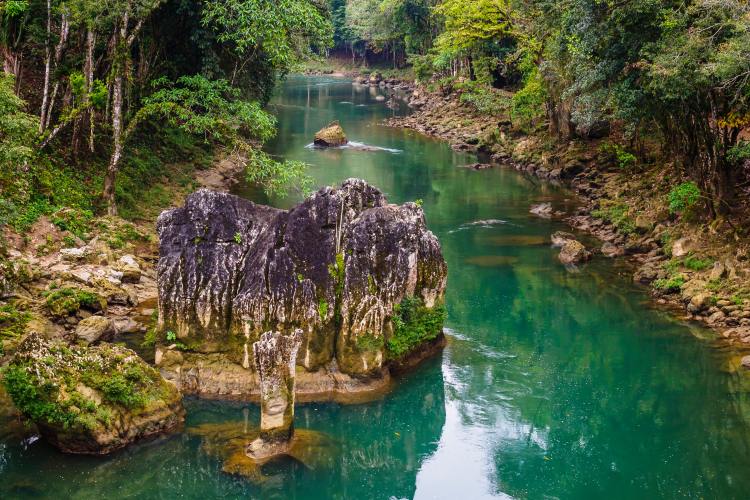
PHOTO: Semuc Champey, Lanquin, Guatemala. Photo by Scott Walmsley, used by permission.

alexander-schimmeck-q1ozzDALUbU-unsplash

NOTE: Semuc Champey is a natural attraction in the mountains of an isolated jungle in Guatemala. Semuc Champey sits above the Cahabón River, in an area where the harder rock on the surface has remained while the river has eroded the softer rock beneath. The pools are a brilliant turquoise color, with the river running beneath them and out the bottom of a large waterfall on the other end. The water in the pools is rain water, which is why it’s so clear.  Learn more here.

PHOTO: Turquoise pool, Semuc Champey (Lanquin, Guatemala). Photo by Alexander Schimmeck on Unsplash

NOTE FROM THE AUTHOR: Semuc Champey is a natural wonder of crystalline pools atop and below a rock bridge, in the jungle of northern Guatemala. Back 20 years and more ago, it was quite difficult to get there — although it was already on the backpacker’s grapevine of places to go for the adventure and beauty. I just learned that Semuc Champey is now a national park. Hopefully that means there’s now more control to make sure people do not jump from the heights into the pools, as had happened when I visited there … the young woman had to be medevaced to her home country, Switzerland.

caputo01-1

ABOUT THE AUTHOR: Lorraine Caputo is a documentary poet, translator, and travel writer. Her work appears in over 180 journals in Canada, the US, Latin America, Europe, Asia, Australia, and Africa, as well as in 12 chapbooks of poetry – including Caribbean Nights (Red Bird Chapbooks, 2014), Notes from the Patagonia (dancing girl press, 2017), and On Galápagos Shores (dancing girl press, 2019). She also pens travel pieces, with stories appearing in the anthologies Drive: Women’s True Stories from the Open Road (Seal Press, 2002) and Far-Flung and Foreign (Lowestoft Chronicle Press, 2012), and travel articles and guidebooks. In March 2011, the Parliamentary Poet Laureate of Canada honored her verse. She has done over 200 literary readings, from Alaska to the Patagonia, and journeys through Latin America, listening to the voices of the pueblos and Earth. You may follow her Latin America Wander travels on Facebook and at latinamericawander.wordpresscom.

Manzanita Lake by Penelope Moffet

IMG_0585

Manzanita Lake
by Penelope Moffet

Shallow Sierra lake more sun-warmed than most
though still fed by snow-melt. Maybe mild in summer
but not in late September, sun ready to go down,
water mirroring trees and mountains. I edge in,
feet sliding over stones and muck, skin
cringing into liquid cold enough to form another skin.
He says to himself, “Am I doing this?
All right, I think I’ll just jump in,”
and goes in fast. Self-preservation keeps
my head dry though I want to do what he does,
free-style. Five minutes and we shiver onto shore.
He says his brain is frozen but his injured knee
thanks him for the cold. The mirror we broke reforms.
Coots and mallards groom away our ruckus, dive.

PHOTO: Manzanita Lake, near North Fork, California.  Photo by Penelope Moffet, used by permission. 

NOTE: Manzanita Lake is a small, manmade lake in Central California, near the town of North Fork. Dating from the early 1940s, during the development of hydro-power, Pacific Gas & Electric owns the facilities and administers the area, which is surrounded by land administered by the Sierra National Forest.  With 26 surface acres and an average depth of 6.5 feet, the lake is situated at 2,900 feet in the foothills of the Sierra Nevada Mountains

NOTE FROM THE AUTHOR: In September 2019, I traveled for two weeks in Northern California, staying whenever possible near lakes I could swim in. The last stop was North Fork, near Yosemite National Park. My airbnb host told me about Manzanita Lake, a small body of water not far away, so when my friend Elliott Almond came to visit I told him we had to go swim in that lake. It was the shortest swim of the trip, as the high-altitude water was cold at the end of September. Nevertheless, it remains a happy memory. 

moffet in santa ynez canyon

ABOUT THE AUTHOR: Penelope Moffet is a Southern California writer whose work has been published in many literary journals, including Silver Birch Press. She is the author of two chapbooks, most recently It Isn’t That They Mean to Kill You (Arroyo Seco Press, 2018). She has work upcoming in Verse-VirtualGleam, and Sheila-Na-Gig.


Julene Tripp Weaver, Finding a Fal Café in Istanbul

turkey kotelnyk licensed

Finding a Fal Café in Istanbul
by Julene Tripp Weaver

We drink healing sherbets—
small aperitif drinks served
in shot glasses before a meal,
between courses—a palate cleanser.
Recipes from the Ottoman dynasty,
fruit or flower petals: cornelian
cherry, grapes, roses, red poppy
                                 sherbets.
We try Turkish coffee, find the
“Turkish Starbucks,” Kahva
Dunyasi, with their watered
down version the traveler
at our hostel from England
complained about. We persist,
find the rich coffee at a Fal Café
served with flavors, cinnamon,
cardamom, and psychics
                                 on call,
turn over your cup for a
grounds reading, a goal fulfilled.
Quite the marvel this real
coffee, made to order, one with
mastic, one with nutmeg. If I
lived in Turkey, I would drink
coffee, find the best cafes. Mostly,
I drank their chai—this city
                                filled with
tea drinkers—I warm my hands
against their tiny tulip cups,
sugar cubes on the side,
no milk. I dream this city a new
home in only a matter of days.

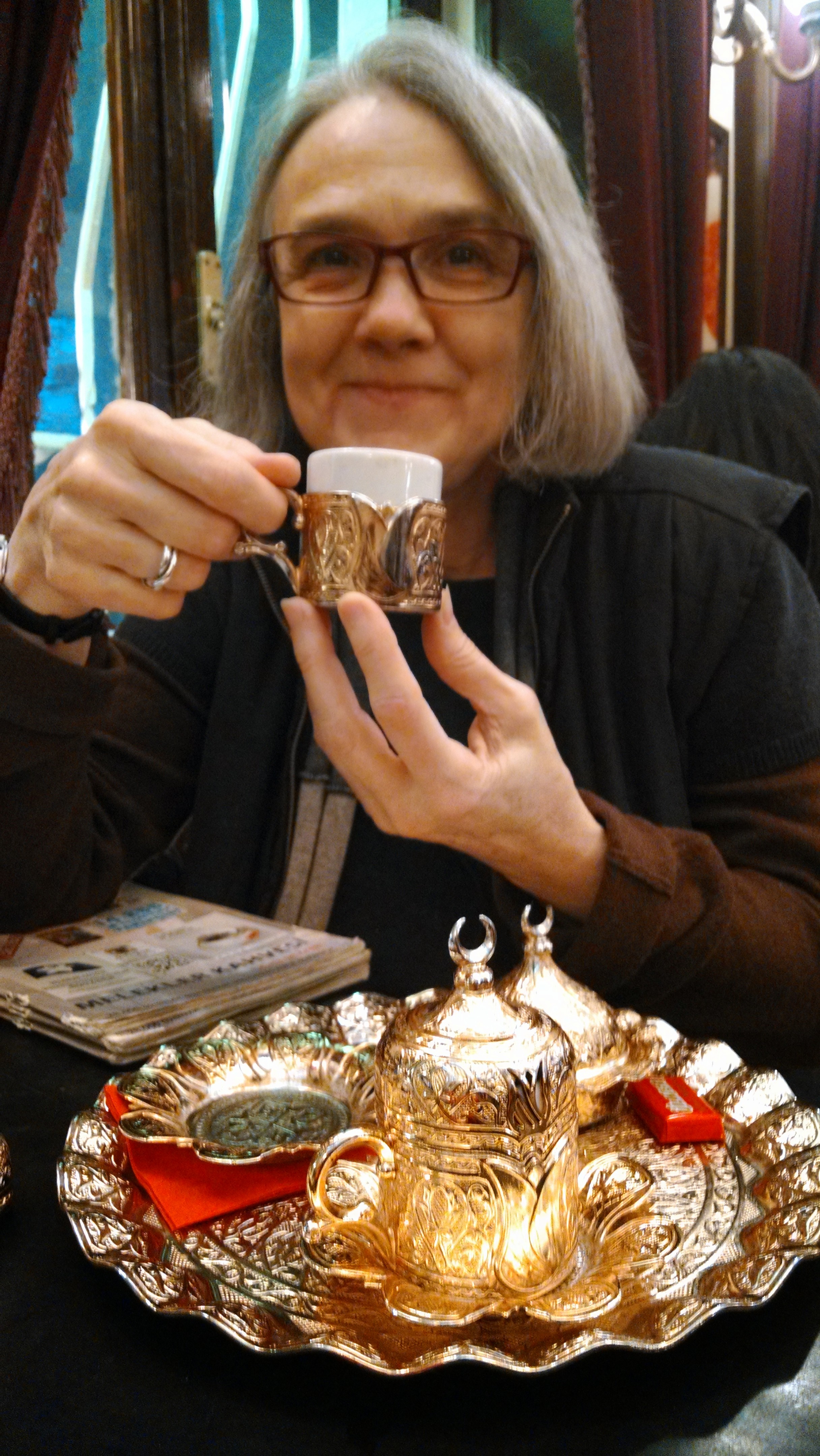
PHOTO: Coffee in Istanbul, Turkey, with Hagia Sophia Grand Mosque in the background. Photo by Kotelnyk, used by permission. 

NOTE: Coffee reading dates back to the 16th Century, with “seers” interpreting symbols viewed in the thick sediment at the bottom of a cup of Turkish coffee. After the coffee in the cup has been enjoyed,  the sediment is left to settle.  The cup is then covered with the saucer and turned upside-down. Coffee readers interpret symbols they see in the sediment, and provide a reading about the individual’s past, present, and future. 

First sip Kahve

NOTE FROM THE AUTHOR: This poem was written after my 2015 trip to Turkey.  The above photo was taken in Istanbul at the Fal Café, where I had my fortune told in coffee grounds. 

ABOUT THE AUTHOR: Julene Tripp Weaver is a psychotherapist and writer in Seattle, Washington. Her third collection, truth be bold—Serenading Life & Death in the Age of AIDS, was a finalist for the Lambda Literary Awards and won the Bisexual Book Award. Her work is published in many journals and anthologies, including Verse-Virtual, The Seattle Review of Books, HIV Here & Now, Mad Swirl, Journal of the Plague Years, Global Poemic, MookyChick, and in the forthcoming Poets Speaking to Poets: Echoes and Tributes; more of her writing can be found at julenetrippweaver.com.

Karlu Karlu by Marilyn Humbert

australia marco saracco licensed

Karlu Karlu
by Marilyn Humbert

The cold, razor wind of July
scarves and scars the round red rocks,
eucalypt leaves sigh in a modulated minor key.

Burnt upright sticks cast slender shadows
and untouched silk white boles flash
in the ghost light of star fall.

He pads soundless, wild and unkempt,
dew dipped hair gleams beneath the full moon’s glare,
snarling lips expose needle-point teeth
as his voice rolls in the rush of river-song.

This night of dingo howls
star sparkles and moonbeams,
he sings of keening kites,

mouse burrows lined with winter-grass
and jigsaw tales of wattle flowers.
He croons the bush curlew’s dirge
through the filaments of dusk and dawn

‘til embers glow blood red
and he fades in the shadows
of Karlu Karlu.

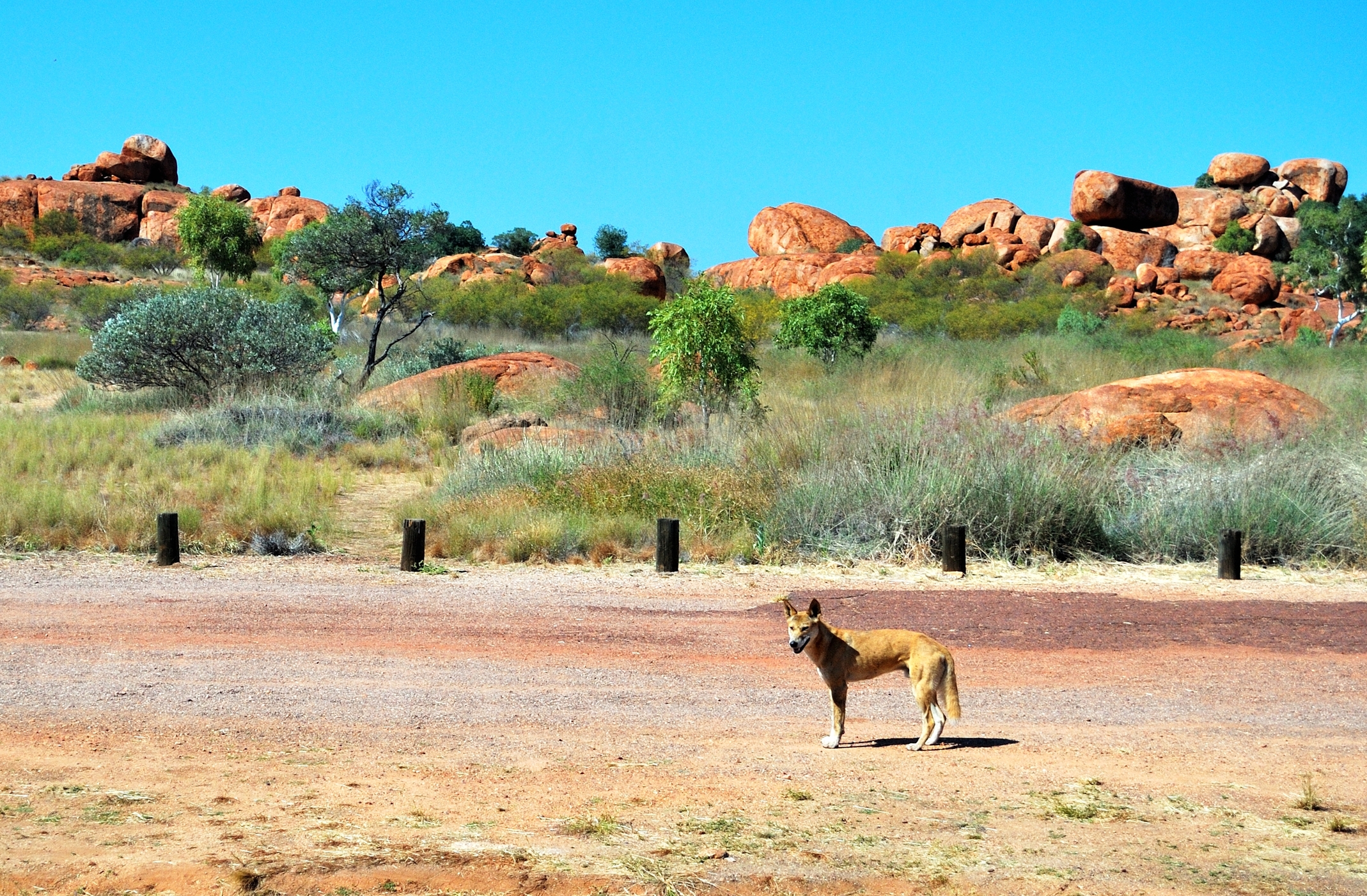
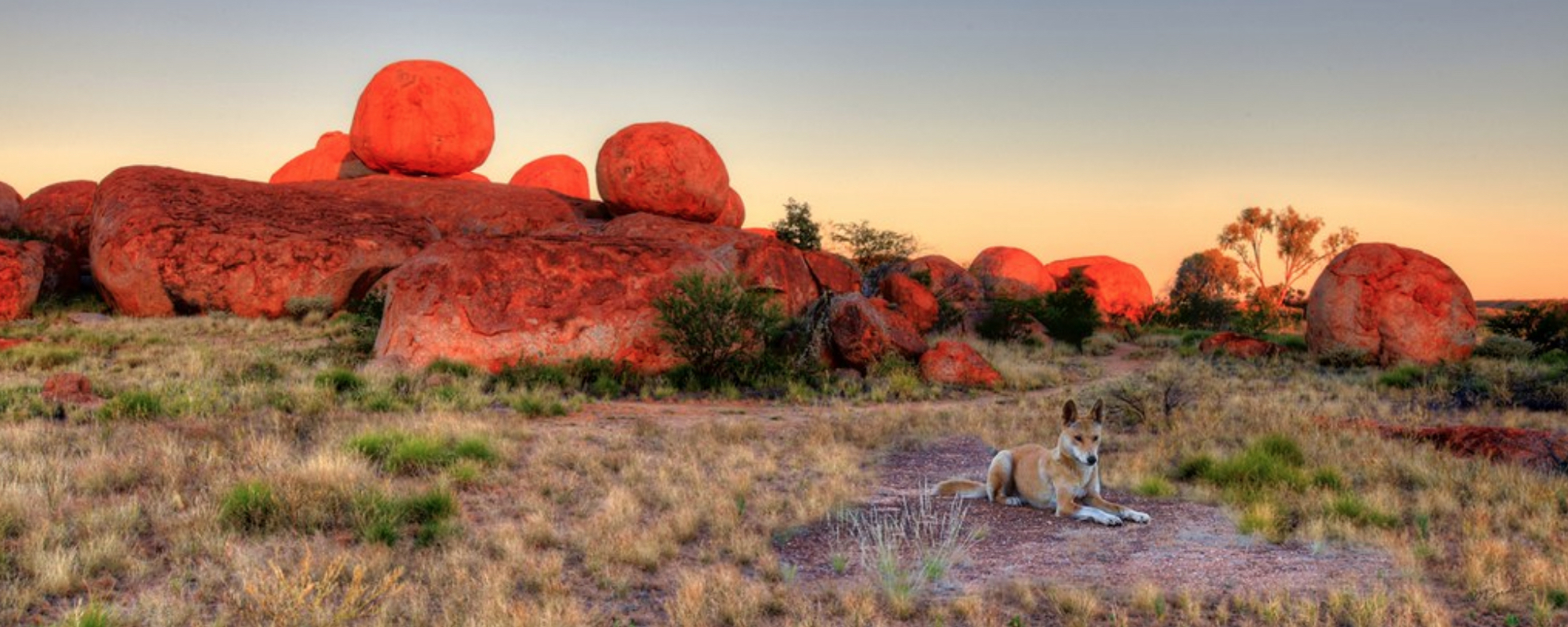
PHOTO: Wild dingo at Karlu Karlu (Devils Marbles), Northern Territory, Australia. Photo by Marco Saracco, used by permission.

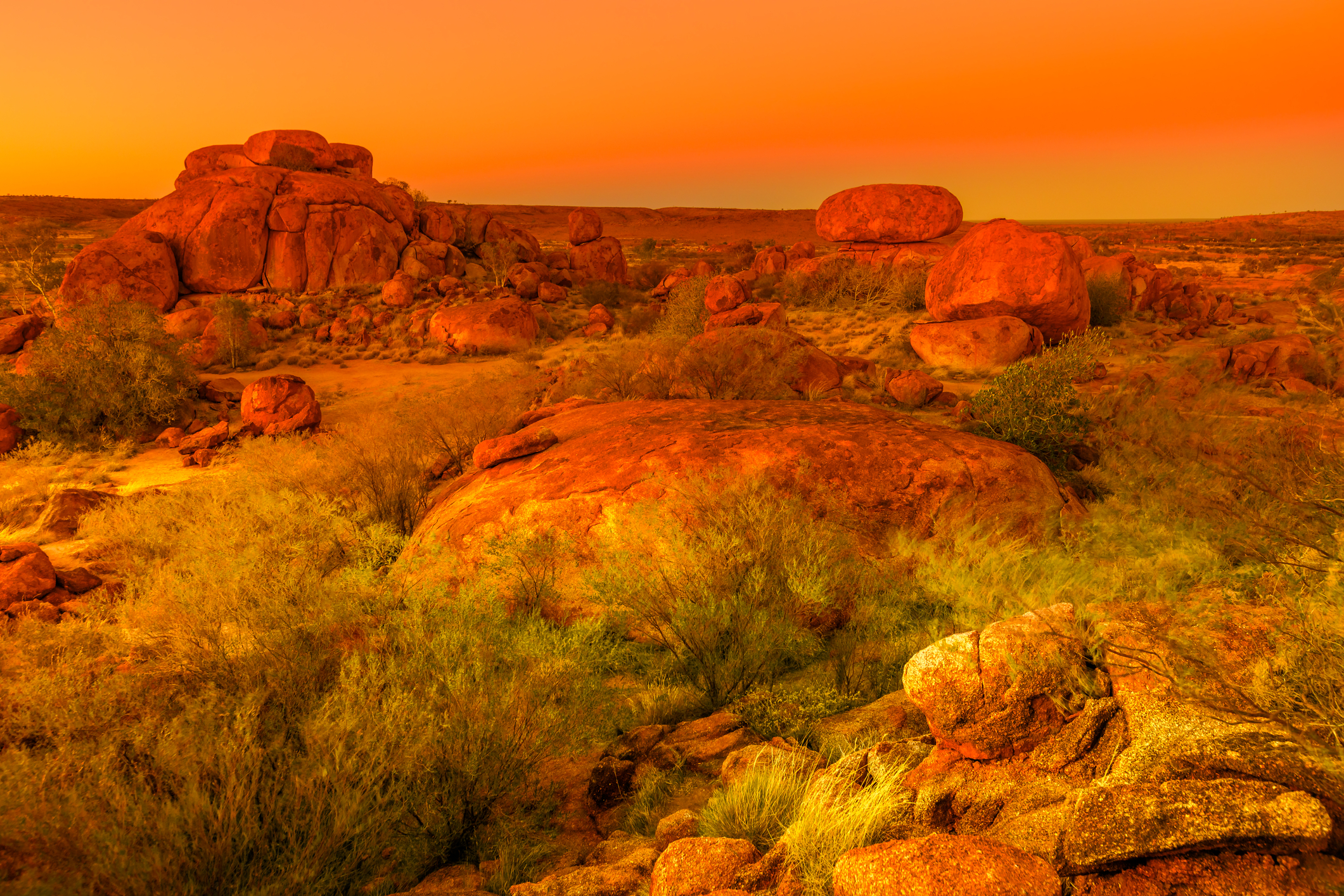
NOTE: Karlu Karlu / Devils Marbles Conservation Reserve is a protected area in the Northern Territory of Australia,  about 244 miles north of Alice Springs.  The area is of great cultural and spiritual significance to the traditional Aboriginal owners of the land, and the reserve protects one of the oldest religious sites in the world as well as the natural rock formations found there. Karlu Karlu is the local Aboriginal term for both the rock features and the surrounding area. The Aboriginal term translates as “round boulders” and refers to the large boulders found mainly on the western side of the reserve. In 2008, ownership of Karlu Karlu/Devils Marbles was officially passed from the Parks and Wildlife Service of the Northern Territory back to the Traditional Owners. The reserve is now leased back to the Parks Service under a 99-year lease, and the site is jointly managed by rangers and Traditional Owners. 

karlu karlu dingo adam gormley

NOTE: The dingo is a wild dog found in Australia, with a habitat that covers most of the continent. As Australia’s most predominant terrestrial predator, dingoes prey on mammals up to the size of the large red kangaroo, in addition to birds, reptiles, and fish. A dingo pack usually consists of a mated pair, their offspring from the current year, and sometimes offspring from the previous year.  The dingo plays a prominent role in the Dreamtime stories of indigenous Australians.

PHOTO: Dingo, Karlu Karlu (Devils Marbles), 2011 by Adam Gormley,  © All Rights Reserved. 

australia benny marty licensed

NOTE FROM THE AUTHOR: We were camped beneath the rocks. This night, just on dusk, a dingo trotted through the campground—bold, nonchalant, without a care—and disappeared into the darkness.

PHOTO: Sunset at Karlu Karlu, Australia. Photo by Benny Marty, used by permission.

photo-marilyn-humbert-copy

ABOUT THE AUTHOR: Marilyn Humbert lives in the Northern suburbs of Sydney, New South Wales, Australia. Her free-verse poems have been awarded prizes in competitions, published most recently in Ethelzine Vol. 6 and Black Bough Poetry Deep Time Vol 2.  Her tanka and haiku appear in international and Australian journals, anthologies, and online.

You Could Have…by Ivanka Radmanović

P8073753-scaled1

You Could Have…
by Ivanka Radmanović

Among the blooming rosemary
soaked by the rain,
under bewildering domes of
black cypresses,
with your face bleached by the storm
and your hair in waterfalls,
barefoot you walk along the old path,
down the ancient stone stairs,
avoiding stepping on soaked
fig leaves, glued to the ground.
behind you: the fortress of spirits from which you now run
ever so slowly, as if you were dancing.
over you: the horrifying, black, unforgiving sky.
In front of you: the half open iron gate, waves, and the gushing sea.
Through the howling wind and the shuddering blinds, I know,
you must hear the broken sound of an old piano.
I watch your descent, in silence,
through the window drowned with rain drops:
your slim body visibly shaking
under the veil of a soaked dress,
your shimmering bare feet with pale pink heels,
the cold fingers of your fine hands
tearing off rosemary leaves in passing,
your eyes as dark as the bristling skies,
your voice as absent as a frightened bird,
your heart that overrides the roar of thunder,
your lack of fear stronger than the broken sea.
I keep quiet. I don’t stop you while your hand
opens the rusty iron gate.
I don’t scream your name through the creaking of hinges
and gusts of wind.
I don’t prevent your descent
towards the seething abyss of water.
all the universe subdued in this garden of paradise,
now unrecognizable:
the roar, and turmoil, and the sea foam,
furious whipping of branches and the white statues
scattered across the garden,
without a cry, without a sigh, without a word:
When will you stop leaving me?

Translated from Serbian by the poet and James Sutherland-Smith

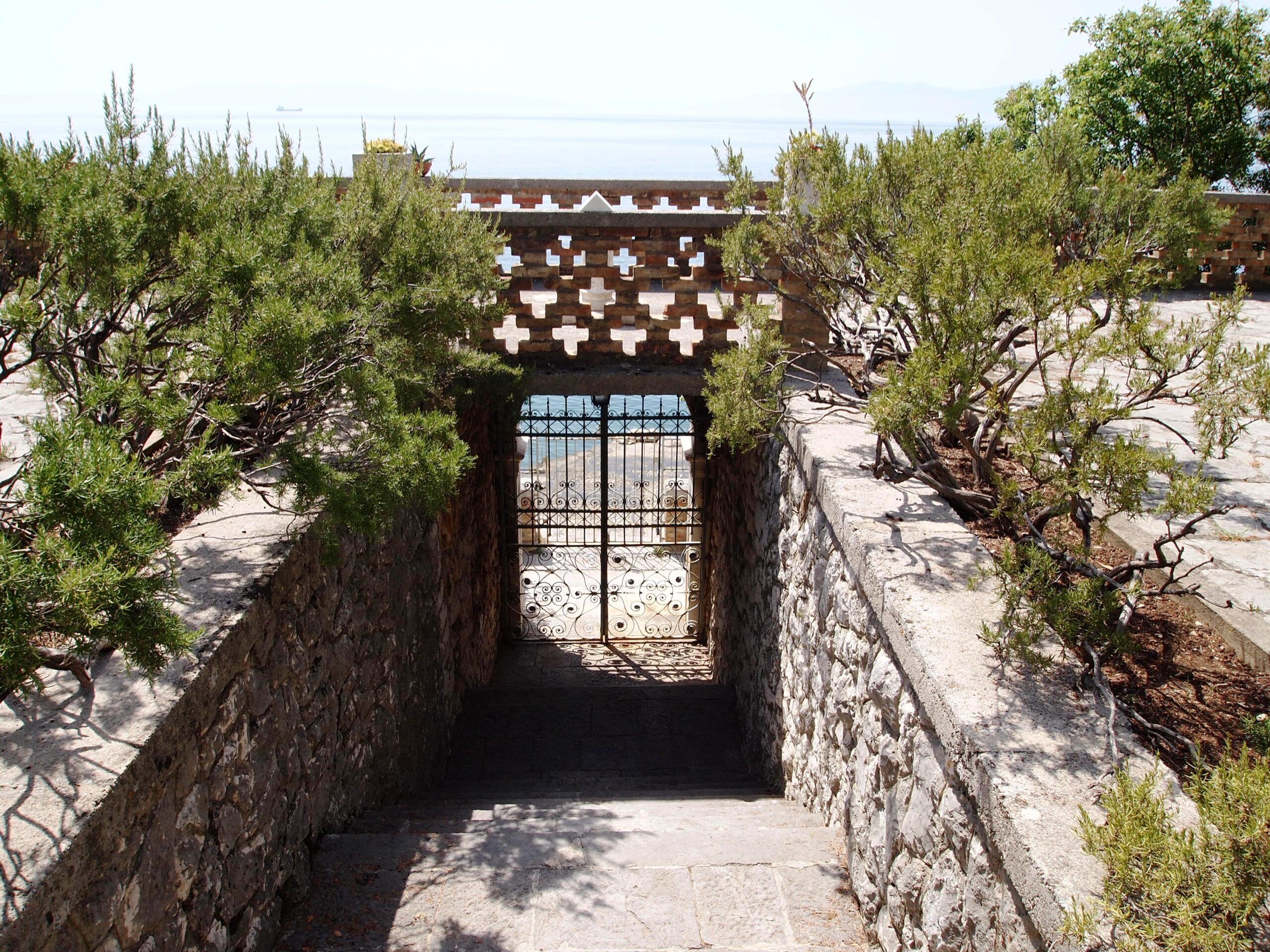
PHOTO: Iron gate and rosemary bushes leading to the Adriatic Sea at the home of author Ivana Brlić-Mažuranić (1874-1938), Rijeka, Croatia, where “You Could Have…” was written.  Photo from visitrijeka.hr.

croatia-1952700_1920

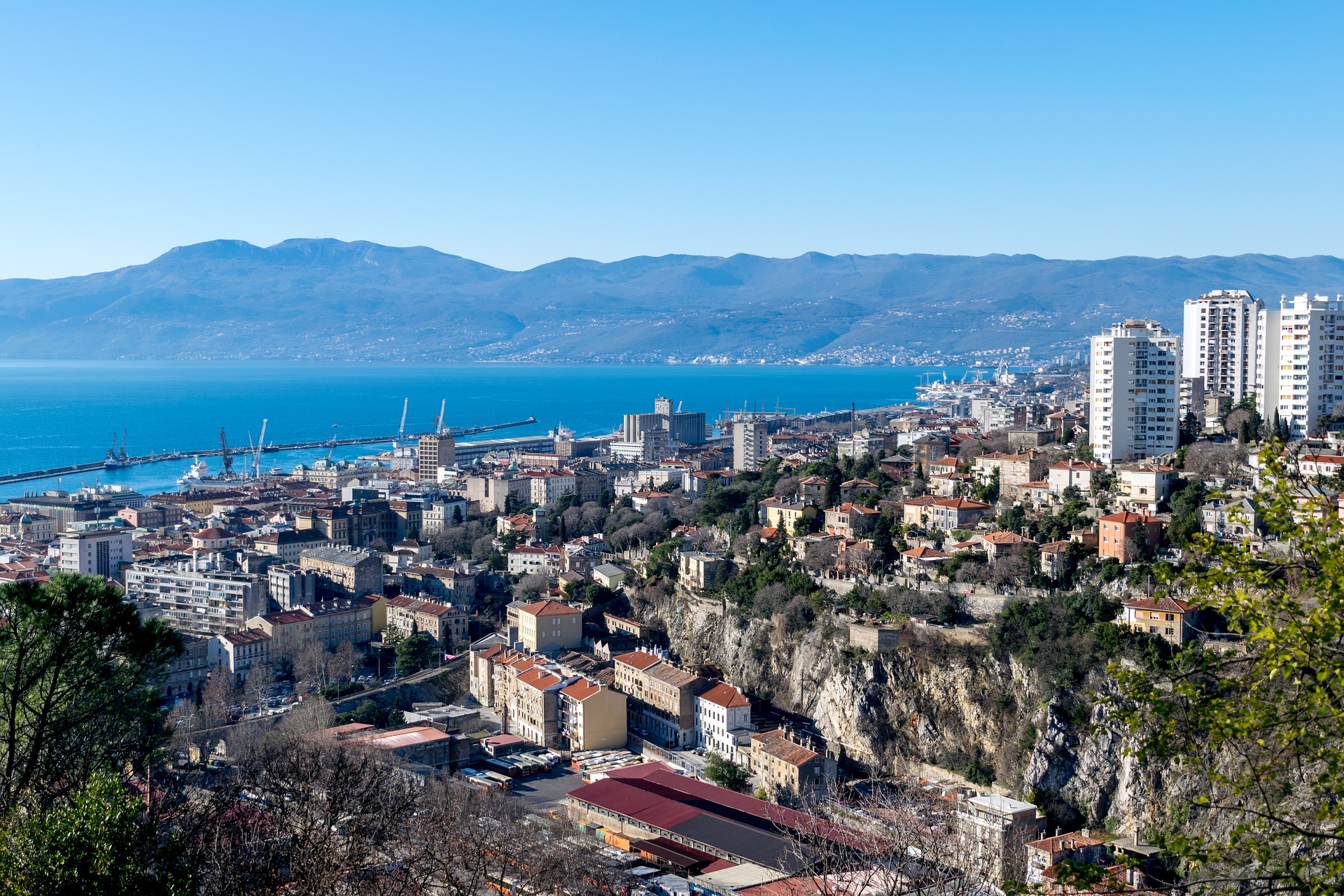
NOTE: Rijeka is the principal seaport and the third-largest city in Croatia. Located on Kvarner Bay, an inlet of the Adriatic Sea, in 2011 Rijeka had a population of 128,624. Because of its strategic position, the city was contested over the centuries by Italy, Hungary, and Croatia.  Rijeka was selected as the European Capital of Culture for 2020, alongside Galway, Ireland.

PHOTO: Rijeka, Croatia. Photo by Ivan Vuksa, used by permission.

Ivanka Radmanovic

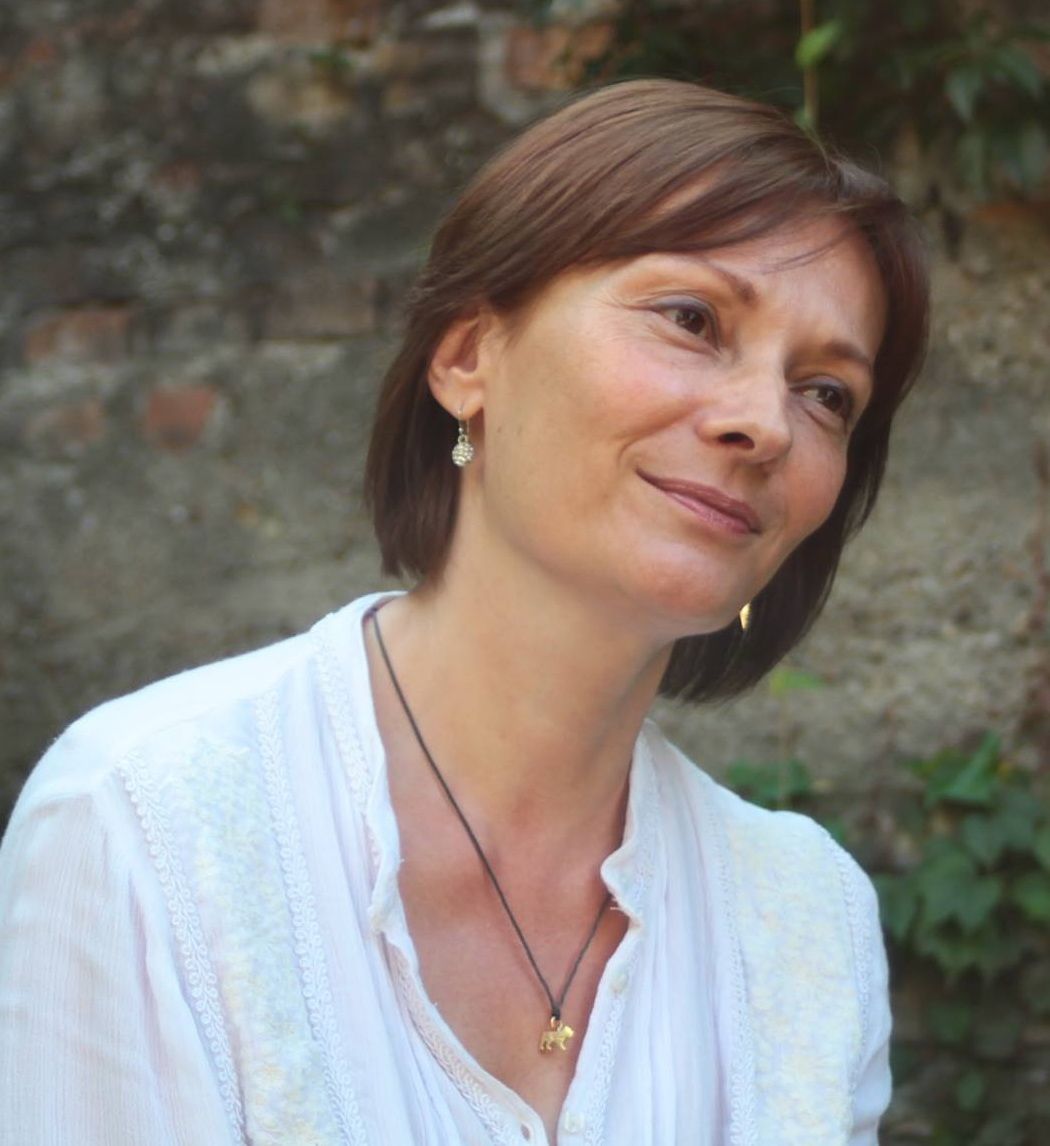
ABOUT THE AUTHOR: Ivanka Radmanović graduated from the Fashion Institute of Technology, Department of Fashion Design in New York City (USA). She has published three collections of poetry: Where is My Home (Где је моја кућа, 2016), Heavenly Cage (Рајски кавез, 2014), and AMARANTH or About Eternal Love (АМАРАНТ или О бесмртној љубави, 2013). For her book Heavenly Cage, in 2015 she received the prestigious Milan Rakic Award. She translates from English, and is a member of the Association of Writers of Serbia, Association of Writers of Vojvodina, and the Association of Scientific and Technical Translators of Serbia.

The Breathing Burren by Maureen Grady

IRELAND paop licensed

The Breathing Burren
by Maureen Grady

There is a world apart,
of elemental beauty carved by glacier,
where tiny wildflowers
pierce through limestone.

No trees grace this rare realm,
a silver stone land with
not enough water to drown,
nor earth to bury,
but fauna and flora
half-hidden, abundant.

Only here
on the vast crust of Earth
do flowers from the Arctic,
the Mediterranean,
and the high Alps
grow side by side
and flourish.

And briefly, in spring,
out of the grey limestone,
the early purple orchid breaks through,
the crowning glory,
the one that draws forth love.

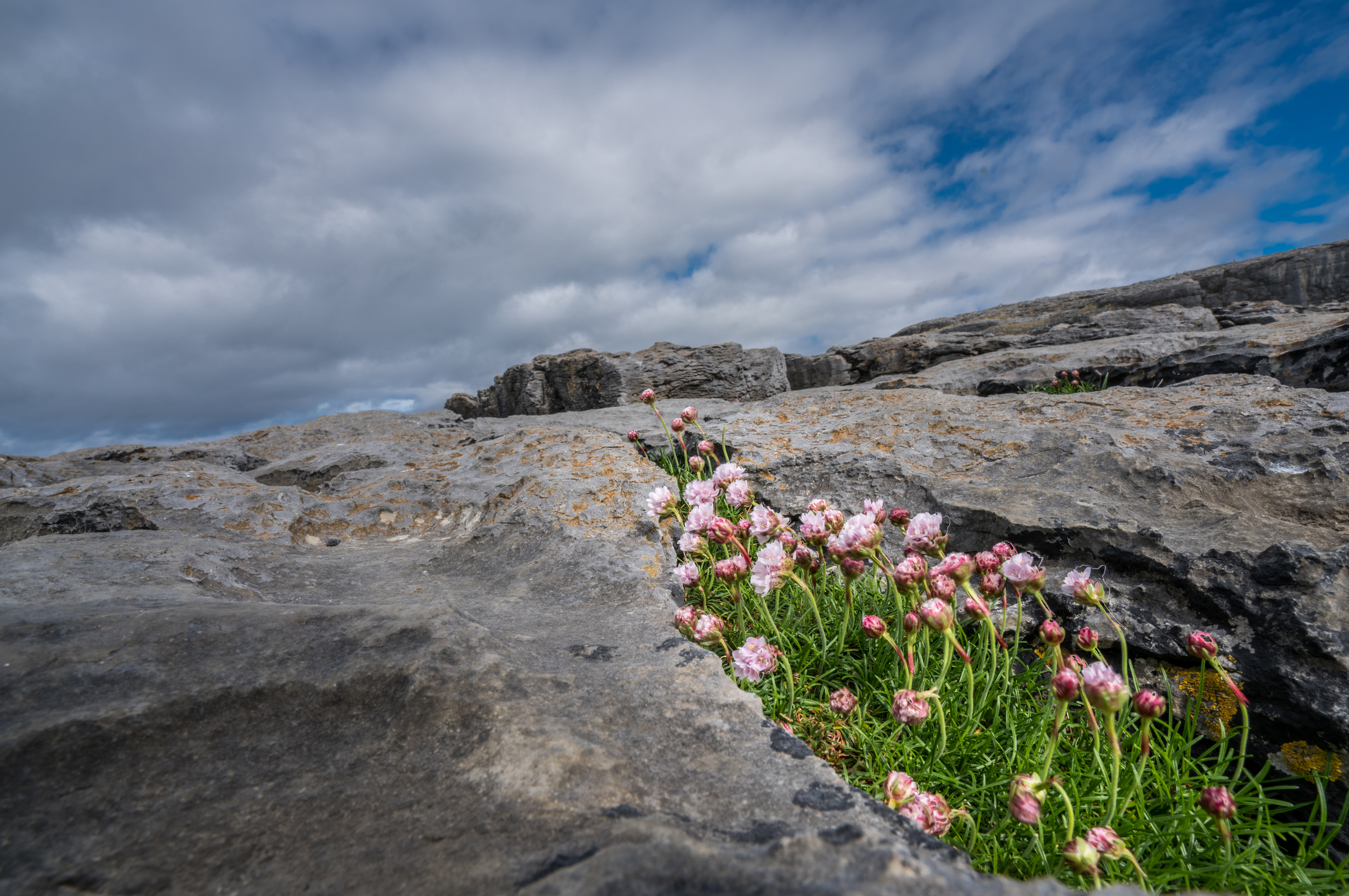
PHOTO: Flowers bloom between rocks on cliffs in Doolin Bay, The Burren, County Clare, Ireland. Photo by Paop, used by permission.

the-burren-981898_1920

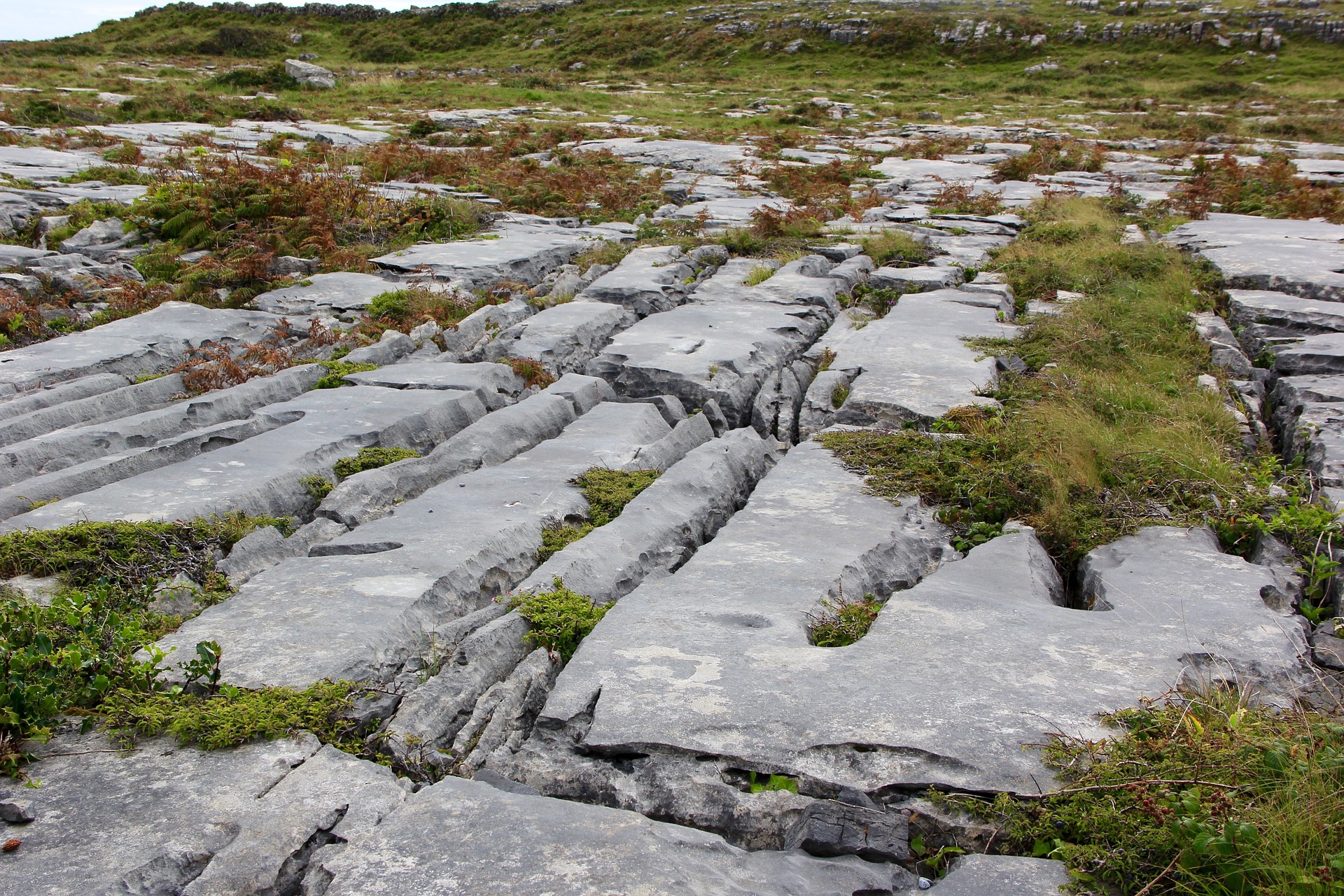
NOTE: The Burren is a region of environmental interest, primarily located in northwestern County ClareIreland, dominated by glaciated karst landscape. The area is formed from sedimentary rocks, largely limestone but also sandstone, mudstone, and siltstone. Renowned for its remarkable assemblage of plants and animals, over 70% of Ireland’s species of flowers are found there.

PHOTO: The Burren, County Clare, Ireland. Photo by Mary Bettini Blank, used by permission.

IMG_8396

ABOUT THE AUTHOR: Maureen Grady is author of two books of poetry: Unpack My Heart With Words (2015), and Land of Dream and Dreamer, Poems of Ireland (2019).  Maureen is a writer, teacher, actor, producer, and private writing coach. She has taught British and Irish Literature, Shakespeare, and Creative Writing for many years. Her private creative writing conservatory has nurtured many young women writers. Maureen was fortunate to have John L’Heureux as a mentor at Stanford, and studied with Seamus Heaney  and Eavan Boland.  She has won two teaching prizes: the student-nominated “One of LA’s Most Inspiring Teachers,” and a national recognition for teaching Creative Writing from Scholastic Books given at Carnegie Hall by Tony Kushner. Maureen is a graduate of Stanford University with a BA in Literature, minor in History/Art History. She also has a Masters in Theatre. Maureen is an citizen of Ireland and the United States, and divides her time between the two countries.

Winter, Lower Longley, Tasmania by Rafaella Del Bourgo

nature-2662688_1920

Winter, Lower Longley, Tasmania
by Rafaella Del Bourgo

with a butter knife I scrape
frost off the inside of the kitchen windows
and there they are again
cow faces with their dark eyes
noses breathing steam
feet stamping in the snow

like the lamb
from the farm up the hill
and the black cat
they want to come in
they want to come in out of the cold
into the house which will be warm
as soon as the logs catch

on the table six ripe apricots
blushed with sun
plump with sweet water all the way from California
flown in then purchased at great expense
from the one market in town

I open the door for the cat
then shut it quickly
against the lamb and a possible cow stampede
sip a cup of coffee
with milk and sugar the way I like it

as snow continues to drift down
the cows wear white caps
white as the lamb who has kicked down his fence again
and is huddled on my back porch

two possums snuffle
snouts to the ground near the woodshed
looking for something to eat
from the Marsupials of Tasmania poster
I learn they are brushtails

Sulphur crested cockatoos winging overhead
screech like rusty hinges
the cows moo in response
the cat wakes up raises her head and yawns
these sounds and the occasional
whoosh of a lone car on our country road
are all that
interrupt the silence of falling snow

we have no radio and no phone
we brought ten albums with us
and I’ve listened to them so often
that now I’m yelling at Waylon Jennings
Either go to the rodeo with Willy
or grow up and stay with your pregnant girlfriend
but whatever the hell you do
just stop your damn whining

I slept all night yet I’m so tired
my husband
is dazzling them at the university
and I fear that the turn my life was supposed to take
has already happened

I am sitting here alone
cows smearing my windows
with their noses and tongues
tilting their heads right and left
the cat on my lap
the lamb taken from the flock
as a plaything for the farmer’s sons
still desolate on my porch

I’m watching the fire burn
and waiting to warm up
and maybe just maybe this is it
even though I’m living somebody else’s life
maybe this is the turn

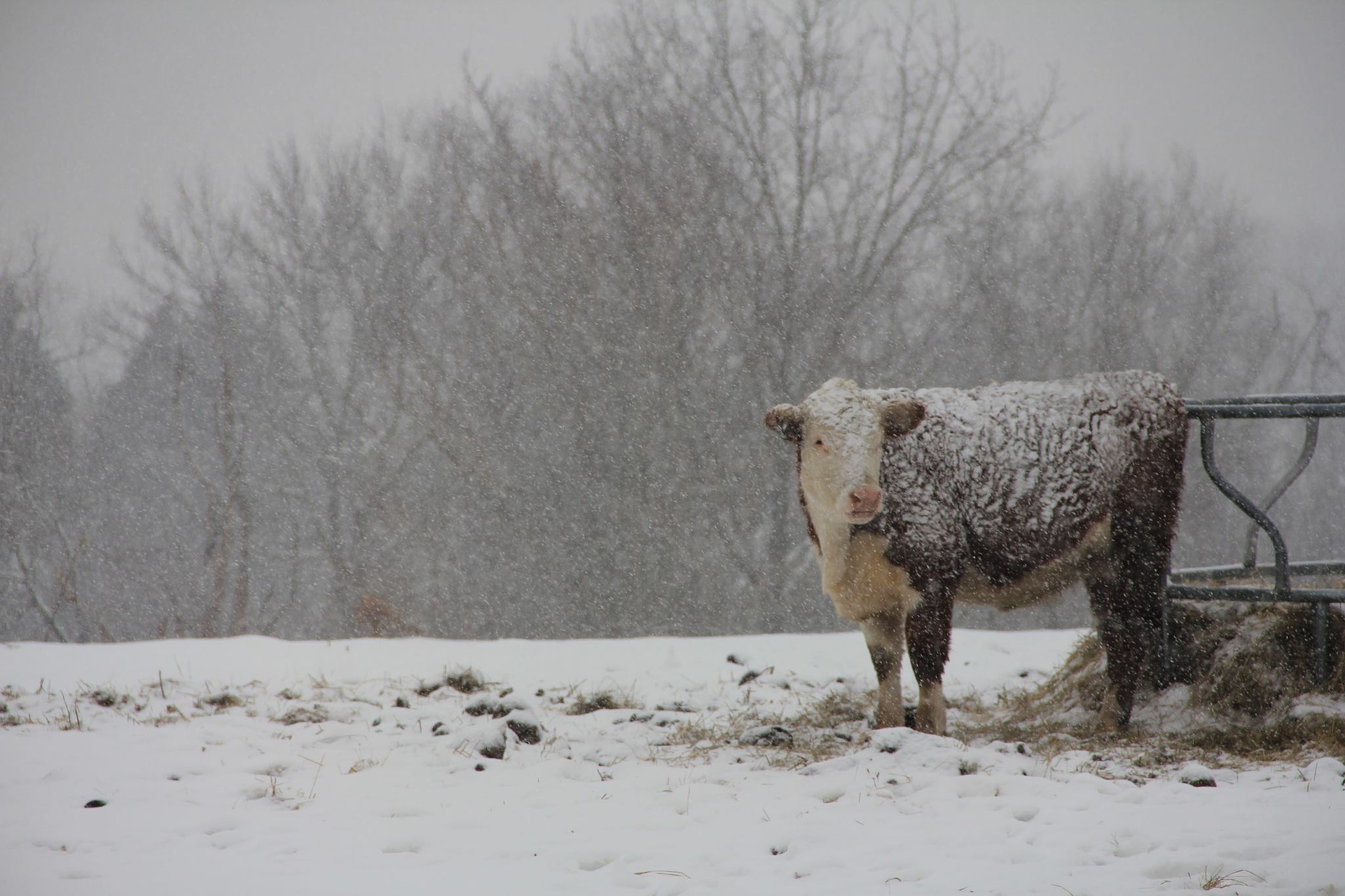
PHOTO: Cow in winter. Photo by Peter Mayer, used by permission.

tasmania tamara bauer licensed

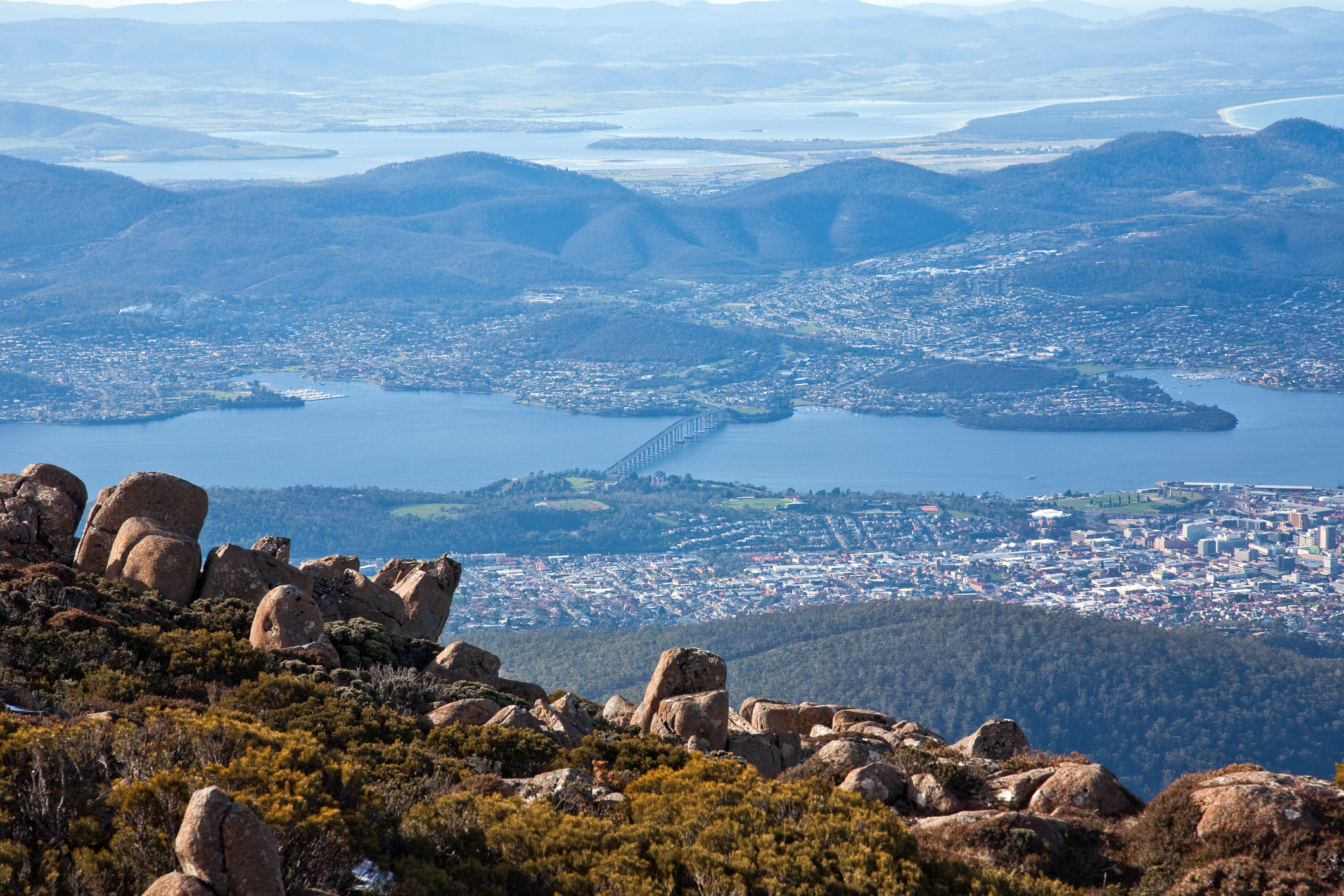
NOTE: Tasmania is an island state of Australia located 150 miles to the south of the Australian mainland. The state, which encompasses the main island of Tasmania and the surrounding 334 islands, has a population of about 540,000 as of March 2020.  Tasmania’s capital and largest city is Hobart, the home to about 40% of the island’s residents. 

PHOTO: View of Hobart, Tasmania, from Mount Wellington. Photo by Tamara Bauer, used by permission.

NOTE FROM THE AUTHOR: During 1976, the glass artist, Richard Marquis, and I spent the year in a 100-year-old schoolmarm’s residence attached to a large one-room schoolhouse outside of Hobart, Tasmania. He had been offered a very  generous year-long artist-in-residence grant by the Australian Arts Board, and he went to the University most days to work in a glass shop he built while students and other teachers watched.

del-bourgo

ABOUT THE AUTHOR: Rafaella Del Bourgo’s writing has appeared in Puerto Del Sol, Rattle, Oberon, Nimrod, and The Bitter Oleander. She has won many awards including the League of Minnesota Poets Prize in 2009. In 2010, she won the Alan Ginsberg Poetry Award. She was also the 2010 winner of the Grandmother Earth Poetry Award.  In 2012 she won the Paumanok Poetry Award.  In 2013 she was the recipient of the Northern Colorado Writers first prize for poetry and in 2014, the New Millennium Prize for Poetry.  In 2017 she won the Mudfish Poetry Prize and was nominated for the third time for a Pushcart Prize.  Her chapbook Inexplicable Business: Poems Domestic and Wild was published by Finishing Line Press.  She lives in Berkeley with her husband and cat.

Ghosts in the Garden by Andrena Zawinski

south carolina c van dyke licensed

Ghosts in the Garden
Epistle from The Battery, Charleston, South Carolina
by Andrena Zawinski

From the city carriage house, from my window inside the piazza,
from here I think I hear them. And there are two of them moving
about below inside a shuffle of whispers. There is a girlish burst
of giggles lilting Gullah tongues. I imagine them there, charmed
by the night, by desire, hooked in the dark into the crooks
of the arms of their own cavaliers, these brown-skinned girls
in genteel Charleston, girls dreaming twilit promenades
wide enough for sweeps of hooped-skirt fashions in from London,
ample as their gentlemen’s gusty promises sweeping the walks,
promises that could lift them swift as evening wind, lift them
with the sudden surprise of thick and musky jasmine sailing in,
their fancies flitting like patches of moonlight fluttering across
oyster shells ground in on the walk, the young heart drifting
with dream and desire.

But at the old Round Church where I propped myself earlier today
in the bright of day against a tree to watch the shadow of a cat lilt
plot to plot, against a sky rumbling low with Charleston’s incoming
afternoon rain–this haunts me now: I think I heard
a gravedigger’s groan, his shovel hit the ground, imagined him
back bent weary, burying six years of smallpox and yellow fever,
a hurricane, the Yamassee raids, all the nuisances of a noisy history.

And now here above this garden of ghosts dark has fallen into,
my thoughts sweep like bees loosened from night corners in a wild
thrum, darting between here and there, between patchy moonlight
and shadows. And I turn over these clamorous thoughts, try
to bury them in the deep plush of my bed in the room above where
horses once stabled. Where I think I hear a bridled mare, the clips
and clomps of her impatient hooves haunting the night. The night
in which a skirt was hooked in the narrow between the kitchen
and main house, when to be a man of property was enough license
to take a girl against her will, tether her with the fury of his passion,
as someone listened above the garden gate carved in hearts afire,
as someone pressed her hands across her ears, slipped inside
a heavy spell of jasmine wrapping the night, slipped into sleep,
into the unbearable inevitability of her own silence.

SOURCE: “Ghosts in the Garden” appears in the author’s collection Something About (Blue Light Press San Francisco)

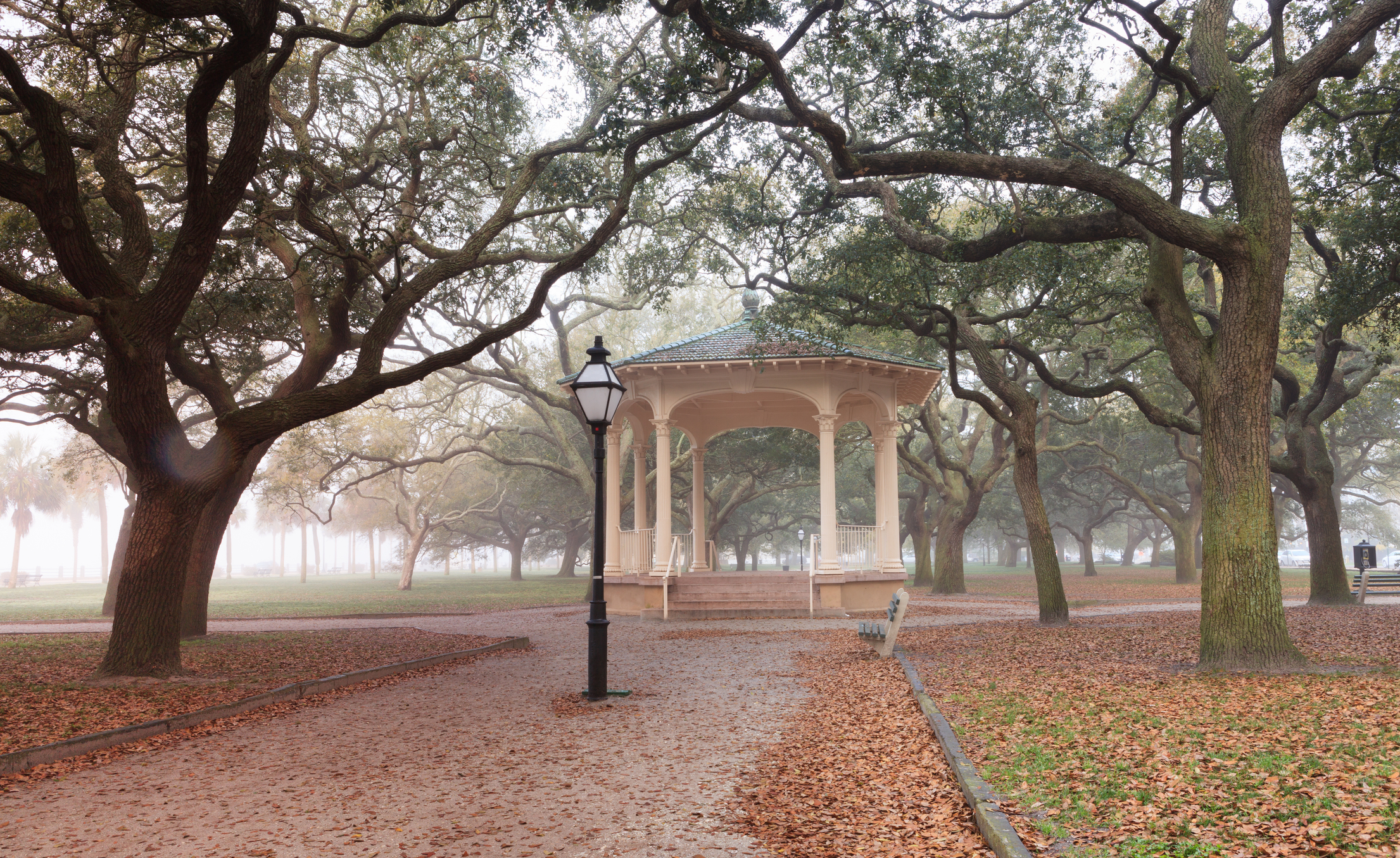
PHOTO: Gazebo in Battery Park, Charleston, South Carolina. Photo by C. Van Dyke, used by permission. 

south carolina sean pavone licensed

NOTE: Charleston is the largest city in South Carolina, with a population in September 2020 of 138,458. The city lies just south of the geographical midpoint of South Carolina’s coastline, on Charleston Harbor, an inlet of the Atlantic Ocean.  Founded in 1670 as Charles Town (later changed to Charleston), to honor King Charles II of England, it was one of the key cities in the British colonization of the Americas. Charles Town played a major role in the slave trade, which laid the foundation for the city’s size and wealth, and was dominated by a slavocracy of plantation owners and slave traders. Historians estimate that nearly half of all Africans brought to America arrived in Charleston. In 2018, the city formally apologized for its role in the American slave trade after CNN noted that slavery “riddles the history” of Charleston. Known for its strong tourism industry, in 2016 Travel + Leisure Magazine ranked Charleston as the best city in the world. Over the last few decades, the magazine has ranked Charleston the best city in the United States based on travel reviews from readers. 

PHOTO: Charleston, South Carolina, French Quarter at twilight. Photo by Sean Pavone, used by permission. 

zawinski-1

ABOUT THE AUTHOR: Andrena Zawinski’s latest poetry collection is Landings from Kelsay Books. Others are Something About from Blue Light Press, a PEN Oakland Award and Traveling in Reflected Light from Pig Iron Press, a Kenneth Patchen Prize. She also has several smaller collections. Her poems have received accolades for free verse, form, lyricism, spirituality, and social concern, and have appeared in Aolean Harp, ArtemisBlue Collar Review, Bryant Literary Review, CaesuraPlainsongs, Progressive Magazine, Rattle, and others with work online at Women’s Voices for Change, Writing in a Woman’s Voice, Verse Daily, and elsewhere. Veteran teacher of writing and feminist activist, she founded and runs the San Francisco Bay Area Women’s Poetry Salon and is longstanding Features Editor at Poetry Magazine.
Karla Linn Merrifield, Sonnet from Sandy’s Deck

alaska chris boswell licensed

Sonnet from Sandy’s Deck
by Karla Linn Merrifield

The many redeye jet flights
to the lower 48 states
are departing Anchorage

as I sit en plein air below
their road, aware I will be
aboard one such vessel tomorrow—

but not now because I sip last
of Alaskan fireweed madness
and local pinot noir tasting

of poetry in larch and spruce
and almost drunken short
summer’s north-shortened sweetness

Last light of midnight sun’s day
that is not-yet-darkness forgets me not

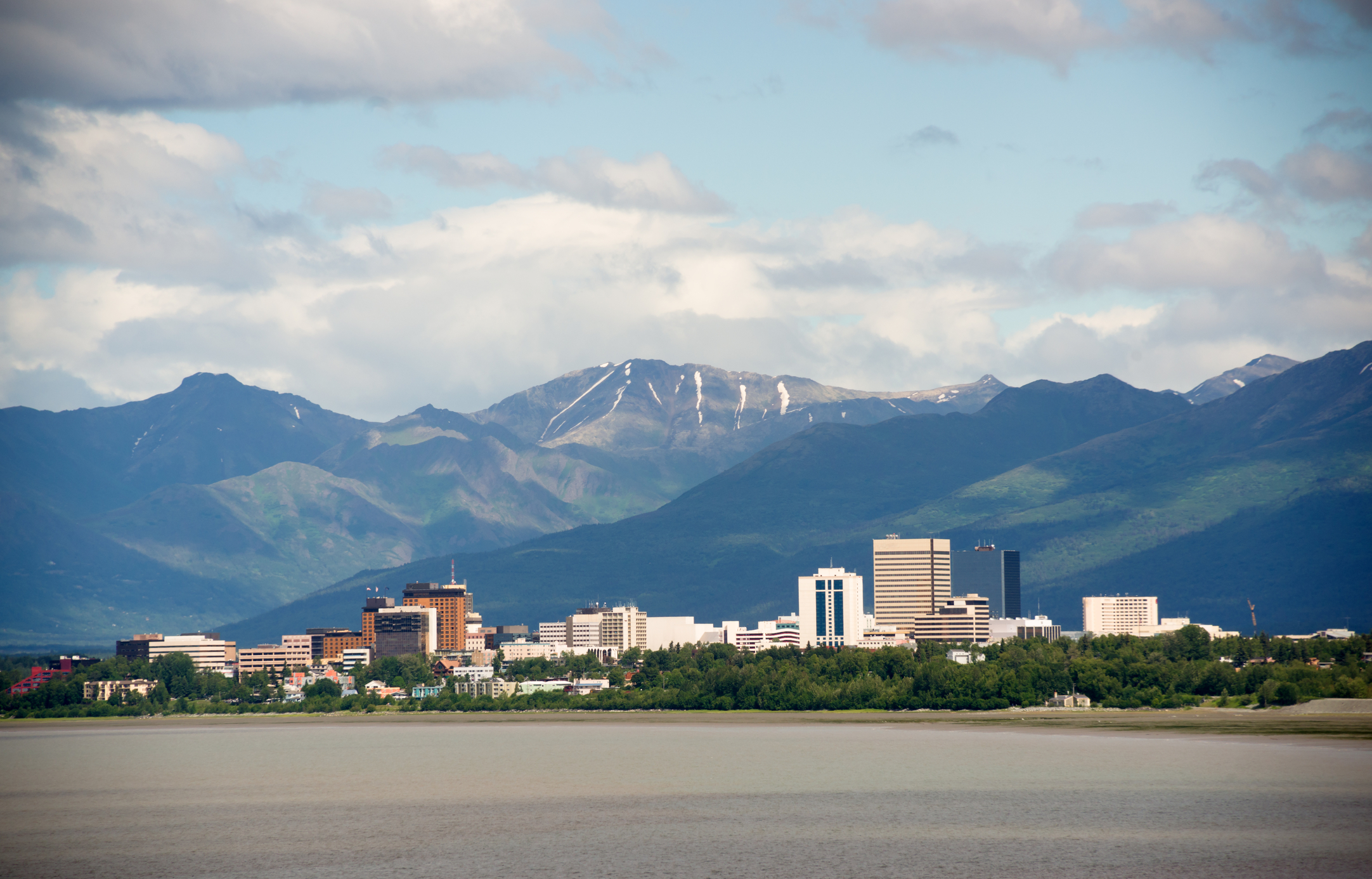
PHOTO: Anchorage, Alaska, downtown skyline in summer. Photo by Chris Boswell, used by permission. 

NOTE: Anchorage, with an estimated 288,000 residents in 2019, is Alaska’s most populous city, where nearly 40% of the state’s population reside; among the 50 states, only New York has a higher percentage of residents who live in its most populous city.  Located in in Southcentral Alaska, almost equidistant from New York City and Tokyo, Anchorage lies within ​nine and a half hours by air of nearly 90% of the industrialized world. For this reason, Ted Stevens Anchorage International Airport is a common refueling stop for international cargo flights. Anchorage has won the All-America City Award four times — in 1956, 1965, 1984–85, and 2002.

Karla Linn Merrifield + Cirque Publisher Sandra Kleven, Anchorage

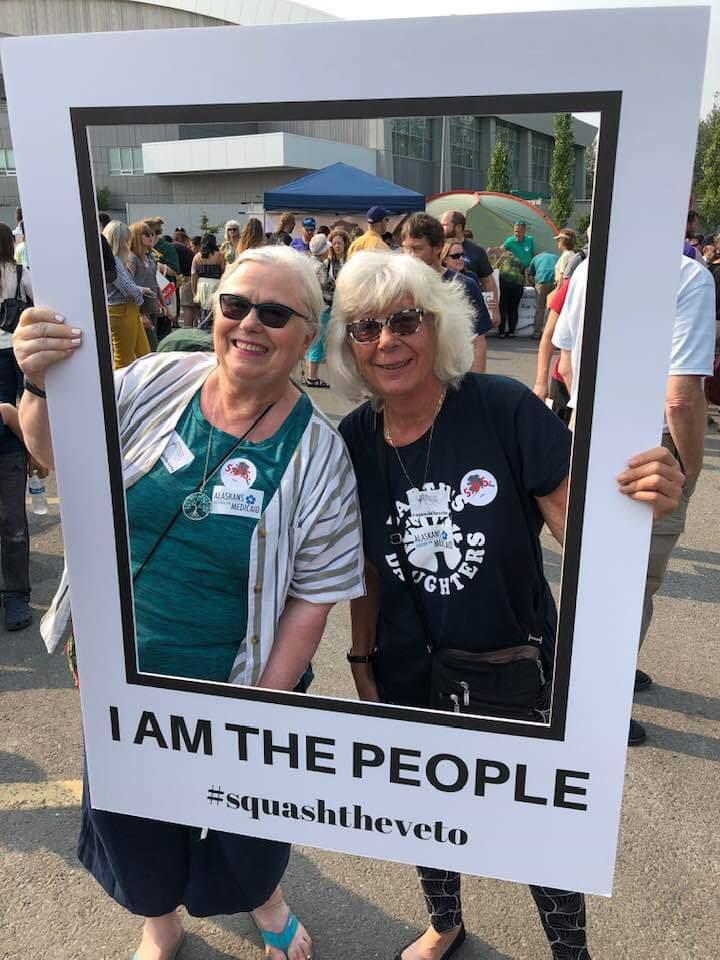
NOTE FROM THE AUTHOR: Upon my return from an expedition on the Bering Sea, I settled down in Anchorage, Alaska, for the launch of my book, Athabaskan Fractal: Poems of the Far North from Cirque Press. It was my good fortune to stay with Cirque publisher Sandra Kleven (at left, pictured with me) during those several days. The poem is my thank you note for her hospitality and enduring friendship.

karla

ABOUT THE AUTHOR: Karla Linn Merrifield has had 800+ poems appear in dozens of journals and anthologies. She has 14 books to her credit. Following her 2018 Psyche’s Scroll (Poetry Box Select) is the 2019 full-length book Athabaskan Fractal: Poems of the Far North from Cirque Press. In early 2021, her Half a World of Kisses will be published by Truth Serum Press (Australia) under its new Lindauer Poets imprint. She is currently at work on a poetry collection, My Body the Guitar, inspired by famous guitarists and their guitars; the book is slated to be published in December 2021 by Before Your Quiet Eyes Publications Holograph Series (Rochester, NY). Find her on Twitter @LinnMerrifiel and on Facebook @LinnMerrifiel.