Once in the Bronx by Gary Beck

1650_Grand_Concourse copy

Once in the Bronx
by Gary Beck

Once I had a girlfriend who lived in the Bronx.
I got lost whenever I visited her.
I vaguely remember her neighborhood,
a resplendent boulevard built to welcome
Napoleon IV, Marshal Foch, General de Gaulle.
But it received instead my urgent lust,
leading me astray in the seven hills,
not of rambling Rome
and the conspiratorial Tiber,
but of less noted waterway, the Bronx River,
already submitting to sludge and squalor.
I never found memorable landmarks.
The Bronx looked like so many other places
in Brooklyn, Queens and Staten Island too.
But the people were calm and untroubled.

I never noticed while I searched for my girlfriend,
how many old people lived in the Bronx.
For the youngsters came home from World War II,
married their girls, packed their bags,
kissed Ma and Pa goodbye
and went to college on the G.I. bill,
The Bronx was not for them.
While they were packing and moving out,
marooning Mom and Pop in oversized apartments.

Once I had a girlfriend who lived in . . . 
I no longer remember her name.
I think my girlfriend was crushed
beneath the wreckage of her house of dreams,
in a once pleasant neighborhood,
now submerged,
somewhere in the Bronx.

SOURCE: A longer version of “Once in the Bronx” appears in the author’s collection, Expectations, and in 2008 was featured in Contemporary American Voices. 

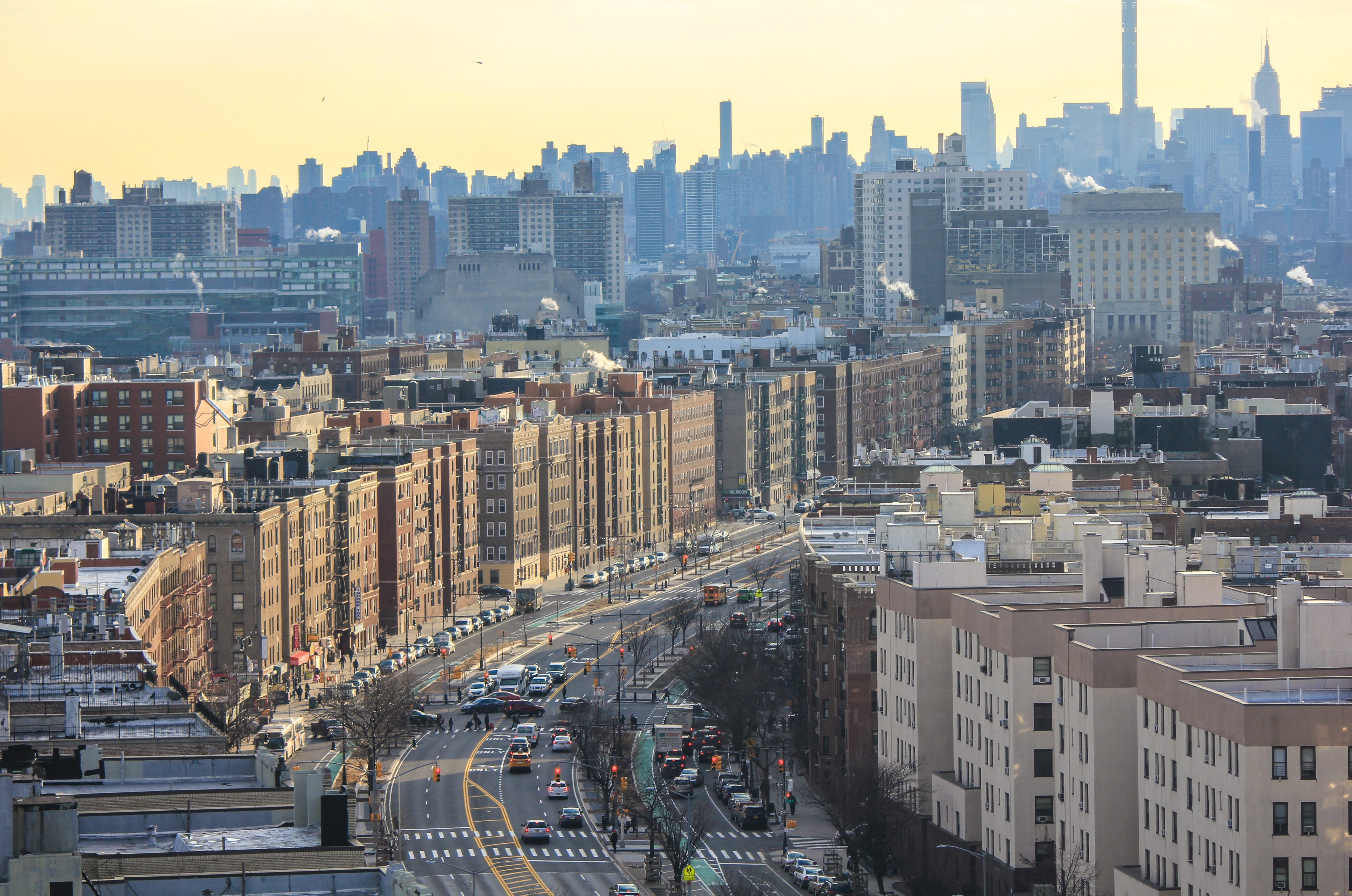
PHOTO: Grand Concourse, the Bronx, New York City, New York, with Manhattan skyline in the background. Photo by Siddarth Hanumanthu, used by permission. 

NOTE: The Grand Concourse (also known as the Grand Boulevard and Concourse) is a 5.2-mile-long thoroughfare in the borough of the Bronx in New York City. For most of its length, the Concourse is 180 feet wide. The Grand Concourse was designed by Louis Aloys Risse, an immigrant from Saint-Avold, Lorraine, France. In 1890, Risse first conceived of the road, and the Concourse was built between 1894 and 1909, with an additional extension in 1927. The development of the Concourse led to the construction of apartment buildings surrounding the boulevard, and by 1939 it was called “the Park Avenue of middle-class Bronx residents.” A period of decline followed in the 1960s and 1970s, when these residences became dilapidated and the Concourse was redesigned to be more motorist-friendly. Renovation and redevelopment started in the 1980s, and a portion of the Grand Concourse was reconstructed starting in the 2000s.
Yankee_Stadium_001 (1)

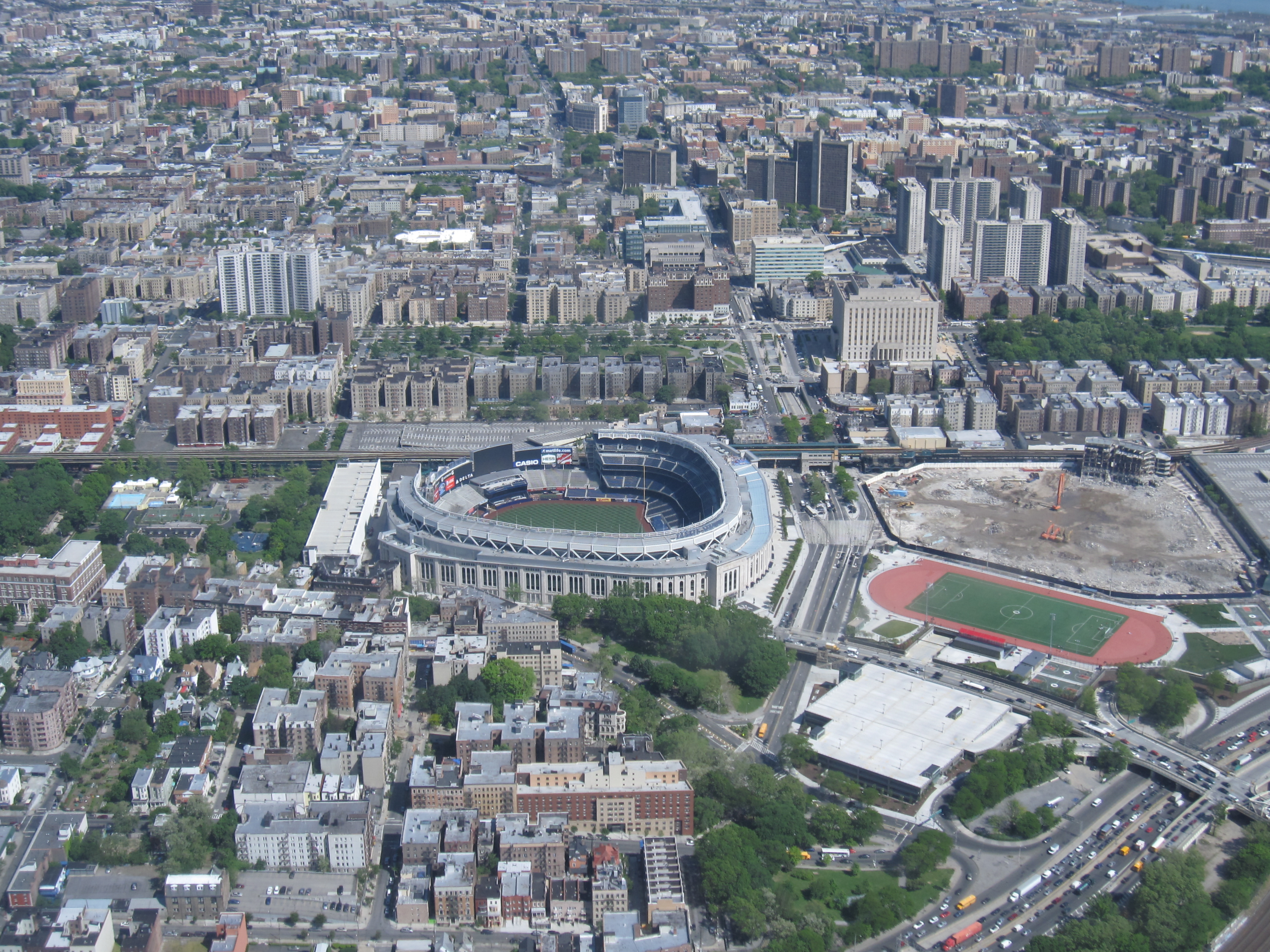
NOTE: The Bronx is a borough of New York City,  New York, northeast and east of  Manhattan, across the Harlem River, and north of Queens, across the East River. The Bronx has a land area of 42 square miles and in 2019 had a population of 1,418,207. About a quarter of the Bronx’s area is open space, including Woodlawn Cemetery, the New York Botanical Garden, and the Bronx Zoo. The name “Bronx” originated with Swedish-born Jonas Bronck, who established the first settlement in the area as part of the New Netherland colony in 1639. The native Lenape were displaced after 1643 by European settlers. In the 19th and 20th centuries, the Bronx received many immigrant and migrant groups as it was transformed into an urban community, first from various European countries (particularly Ireland, Germany, Italy, and Eastern Europe) and later from the Caribbean region (particularly Puerto Rico, Haiti, Jamaica, and the Dominican Republic), as well as African American migrants from the southern United States.

PHOTO: Aerial view of the Bronx, with Yankee Stadium center. Photo by Griffindor, Wikimedia Commons, used by permission. 
gary b

ABOUT THE AUTHOR: Gary Beck has spent most of his adult life as a theater director and worked as an art dealer when he couldn’t earn a living in the theater. He has also been a tennis pro, a ditch digger, and a salvage diver. His original plays and translations of Molière, Aristophanes, and Sophocles have been produced Off Broadway. His poetry, fiction, and essays have appeared in hundreds of literary magazines and his published books include 30 poetry collections, 13 novels, three short story collections, a collection of essays, and three books of plays. Published poetry books include: Dawn in Cities, Assault on Nature, Songs of a Clerk, Civilized Ways, Displays, Perceptions, Fault Lines, Tremors, Perturbations, Rude Awakenings, The Remission of Order, Contusions, and Desperate Seeker. Additional titles include Earth Links, Too Harsh For Pastels, Severance, Redemption Value, Fractional Disorder, Disruptions, and Ignition Point. His novels include Extreme Change, State of Rage, Wavelength, Protective Agency, and Obsess. His short story collections include: A Glimpse of Youth (Sweatshoppe Publications), Now I Accuse and other stories (Winter Goose Publishing), and Dogs Don’t Send Flowers and other stories (Wordcatcher Publishing). Other work includes Collected Essays of Gary Beck (Cyberwit Publishing), The Big Match and other one act plays (Wordcatcher Publishing), Collected Plays of Gary Beck Volume 1, and Plays of Aristophanes translated, then directed by Gary Beck. Gary lives in New York City. Visit him at garycbeck.com and on Facebook

Theatre of the Bay by Roger Patulny

photo 1

Theatre of the Bay
by Roger Patulny

The amphitheatre of the Derwent
befits the frothy wedge-led streaks
tacking through at dawn
bilges taut with Antarctic water

we fold out seats in Lindisfarne
beneath gum trees regenerating high and hairy on the Natone Trail
our bubbly propped on convict walls, we
cheer and lift cold boots as
off-lead puppies thunder underfoot

bushwalkers sight phones along the cables
linking solar-paneled weatherboards and dishes
aimed at Wellington’s disdainful horns
clear across the bay, poking proudly from his upturned face
chin barred, lined and shaved of cloud

the follicles instead decline
on Pinnacle Road carpark
condensing in the hiker’s beards
and beading the ropes of canyoners

before blowing through the New Town like a movie set
a slick westerly buffeting the uplifted helmets
of the e-bikes powering around the bay
chasing the microcosmic drama as

white scalpels shear the pod-feet of the Tasman Bridge
the great grey centipede humpbacked across the Derwent
nervous of triangles
gingerly favoring remaining legs.

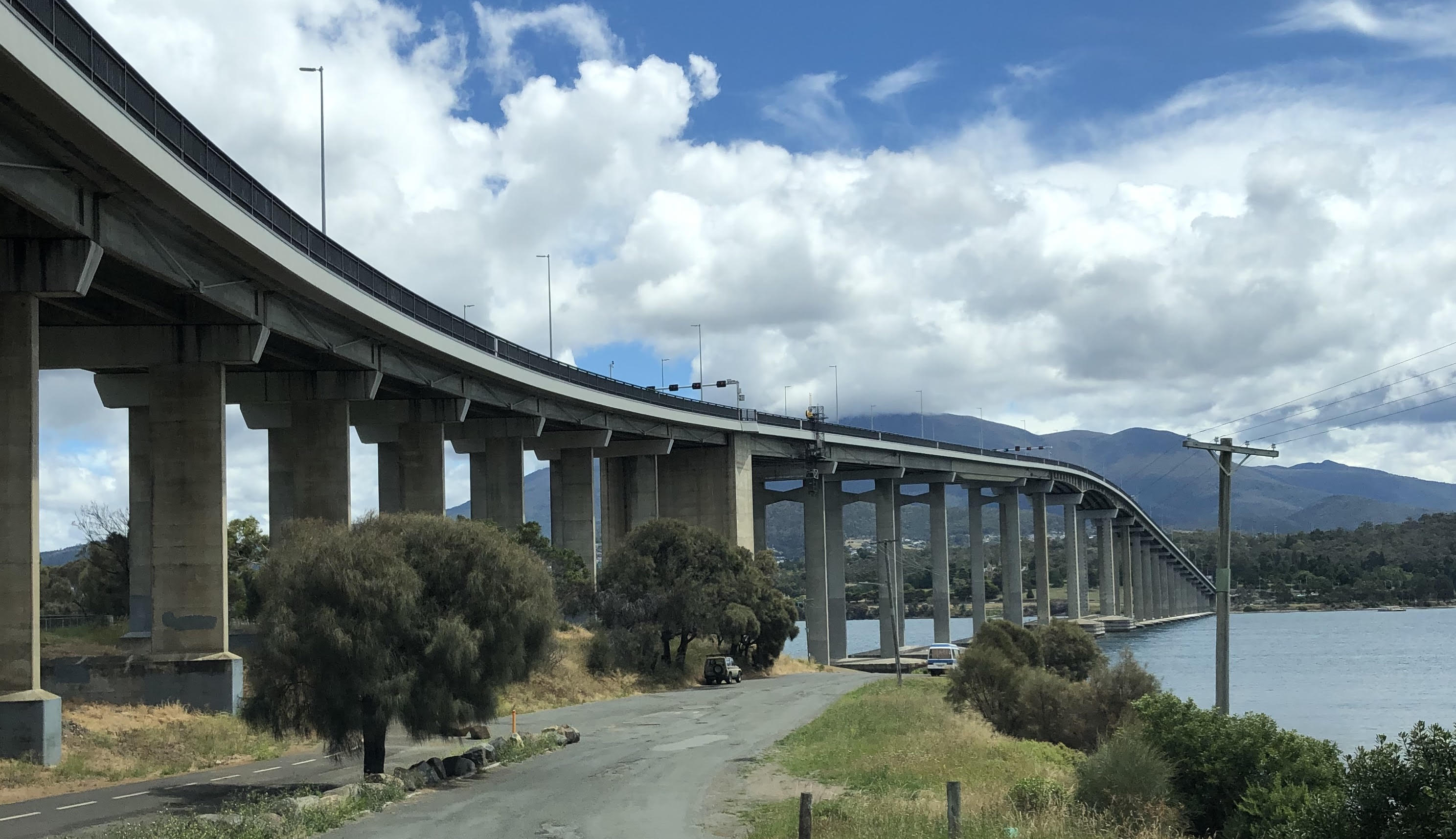
NOTE FROM THE AUTHOR: I hope this photo of the Tasman Bridge offers the centipede feel I was trying to convey in my poem. You can also see Mt. Wellington in the background, though unfortunately covered in cloud at the top (as per usual). Thanks to my brother for taking this shot. 

PHOTO: Tasman Bridge by Alex Patulny. 

Tasman_Bridge1

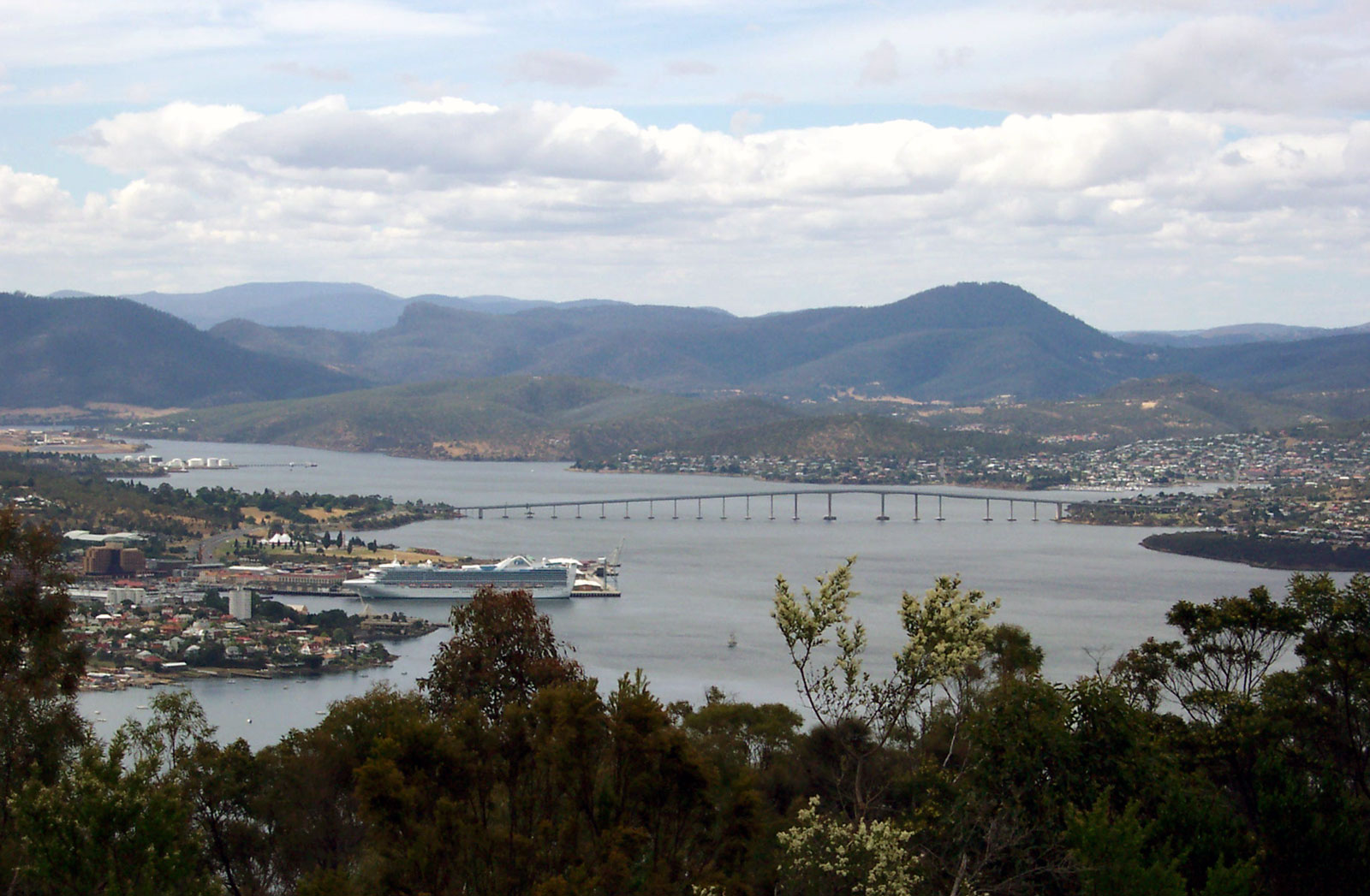
NOTE: The Tasman Bridge carries the Tasman Highway over the Derwent River in  HobartTasmania, Australia. The bridge officially opened on March 18, 1965, and has a total length of 4,580 feet. 

PHOTO: Tasman Bridge over Derwent River, Hobart, Tasmania, Australia. Photo by Enoch Lau, used by permission. 

View_of_the_Tasman_Bridge_from_Kalatie_Road_Montague_Bay_looking_toward_the_Powder_Jetty_over_Cuthbertson's_Boat_shed_(1975)_(16200189861)

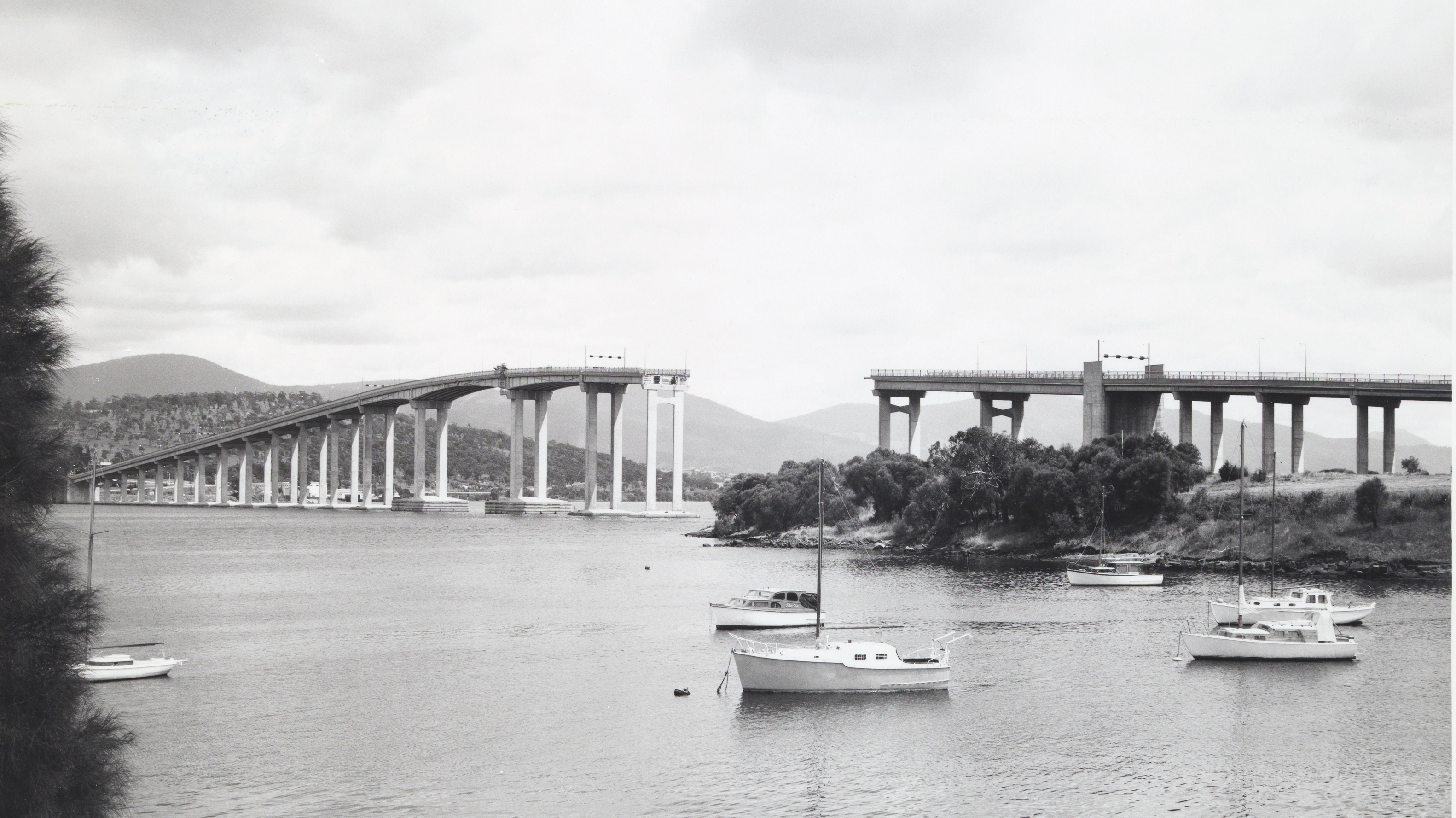
NOTE FROM THE AUTHOR: This poem is based on recollections of Hobart around the time of the annual Sydney to Hobart Yacht Race. The final line refers to the 1975 Tasman Bridge Disaster, where a pylon was destroyed when struck by a bulk ore carrier–the gap it is still plainly visible today.

PHOTO: On January 5, 1975, a bulk ore carrier traveling up the Derwent River collided with several pylons of the Tasman Bridge, causing a large section of the bridge deck to collapse onto the ship and into the river below. Twelve people were killed, including seven crew onboard the ship, and the five occupants of four cars that fell 150 feet after driving off the bridge. Photo courtesy of Tasmanian Archives and Heritage Office. 

roger

ABOUT THE AUTHOR: Roger Patulny is based in Sydney, Australia. He is an academic, writer, and poet, with fiction published in the The Suburban Review and poems in CorditePoets Corner InDaily, the UK arts magazine Dwell TimeThe Rye Whisky ReviewIndolent Books, and the Mark Literary Review. Excerpts and links to Roger’s recent published creative works can be found here.    

Night Journey, poem by Theodore Roethke with photograph by Corky Lee

goldenspike2014b

Night Journey
by Theodore Roethke

Now as the train bears west,
Its rhythm rocks the earth,
And from my Pullman berth
I stare into the night
While others take their rest.
Bridges of iron lace,
A suddenness of trees,
A lap of mountain mist
All cross my line of sight,
Then a bleak wasted place,
And a lake below my knees.
Full on my neck I feel
The straining at a curve;
My muscles move with steel,
I wake in every nerve.
I watch a beacon swing
From dark to blazing bright;
We thunder through ravines
And gullies washed with light.
Beyond the mountain pass
Mist deepens on the pane;
We rush into a rain
That rattles double glass.
Wheels shake the roadbed stone,
The pistons jerk and shove,
I stay up half the night
To see the land I love.

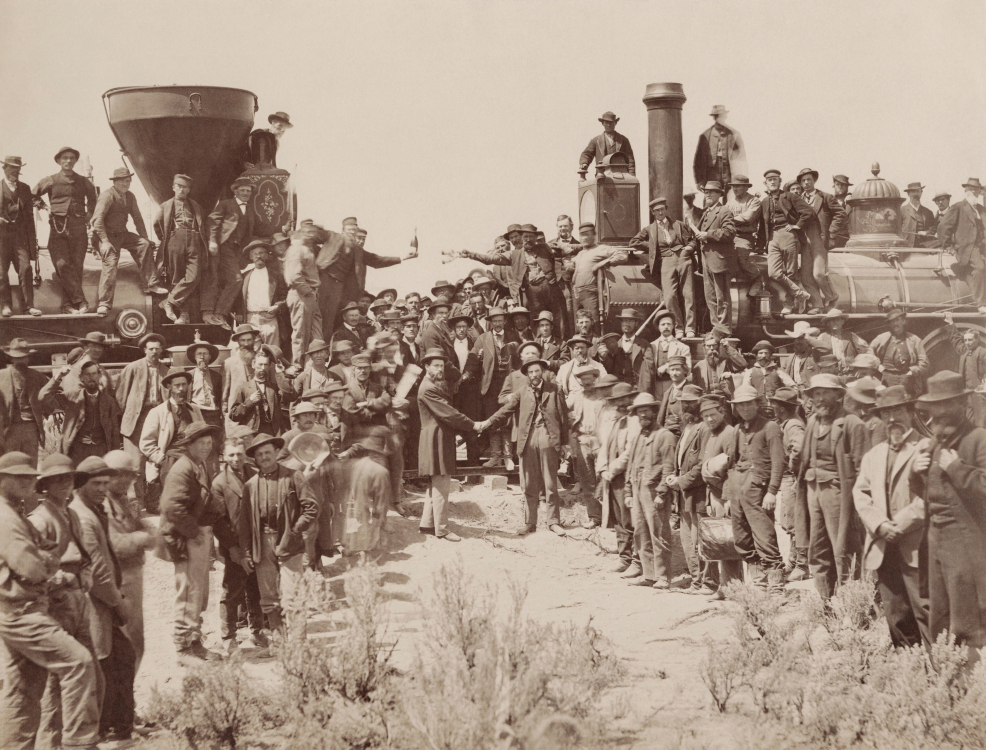
PHOTO: In 2014, on the 145th anniversary of the transcontinental railroad’s completion at Promontory Summit, Utah, photographer Corky Lee invited descendants of Chinese workers to recreate the 1869 photo taken without their ancestors who helped build the railroad. Photo (c) Corky Lee, All Rights Reserved, used by permission.  

CHINESE RR WORKERS

NOTE: Between 1863 and 1869, as many as 20,000 Chinese workers helped build the treacherous western portion of the Transcontinental Railroad that began in Sacramento, California. When not enough white men signed up, the railroad began hiring Chinese men for the backbreaking labor. Chinese workers blasted tunnels through mountains, cut through dense forests, filled deep ravines, constructed long trestles, and built enormous retaining walls. Chinese workers were paid 30-50% less than their white counterparts and were given the most dangerous work. As they approached the meeting point with the Union Pacific at Promontory Summit, Utah, thousands of Chinese workers laid down 10 miles of track in less than 24 hours. Progress came at great cost: Chinese civic organizations retrieved an estimated 1,200 bodies along the route and sent them to China for burial. The transcontinental railroad’s completion allowed travelers to journey across the country in a week—a trip that had previously taken more than a month. Politicians pointed to the country’s great achievement, failing to mention the foreign-born workers who had made it possible. Source: “Remember the Chinese immigrants who built America’s first transcontinental railroad” by Gordon H. Chang, professor of history, Stanford University, Los Angeles Times, May 10, 2019.

PHOTO: Chinese workers toil in a treacherous stretch of the Transcontinental Railroad in California’s Sierra Nevada Mountains, late 1860s. (Source: National Park Service.)

east_and_west_shaking_hands_at_the_laying_of_last_rail_union_pacific_railroad_-_restoration

NOTE ON PHOTO: This photo depicts the ceremony on May 10, 1969 for installing the golden spike at Promontory Summit, Utah, representing the completion of the First U.S. Transcontinental Railroad. At center left, Samuel S. Montague, Central Pacific Railroad, shakes hands with Grenville M. Dodge, Union Pacific Railroad (center right). They are surrounded by men who built the railway—but Chinese workers were not included in the celebration. 

Photo: Andrew J. Russell, Yale Collection of Western Americana, Beinecke Rare Book and Manuscript Library, Yale University, New Haven, Connecticut, used by permission.)

plaque_at_promontory_summit_ut

PHOTO: Plaque at Promontory Summit, Utah, placed in 1969 to commemorate the centennial of the U.S. Transcontinental Railroad and to honor “the Chinese workers of the Central Pacific Railroad whose indomitable courage made it possible.”

roethke-theodore

ABOUT THE AUTHOR: Theodore Roethke (1908-1963) is regarded as among the most accomplished and influential poets of his generation. Roethke’s work is characterized by its introspection, rhythm, and natural imagery. He was awarded the Pulitzer Prize for poetry in 1954 for his book, The Waking, and he won the annual National Book Award for Poetry twice, in 1959 for Words for the Wind and posthumously in 1965 for The Far Field. In the November 1968 edition of the Atlantic Monthly, former U.S. Poet Laureate and author James Dickey wrote Roethke was: “…in my opinion the greatest poet this country has yet produced.” In 2005, Library of America published Theodore Roethke: Selected Poems.

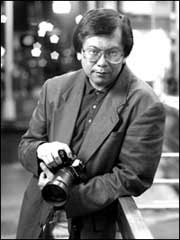
corky lee

ABOUT THE PHOTOGRAPHER: Young Kwok “Corky” Lee (1947 – January 27, 2021) was a renowned photographer whose work chronicled Asian American culture. Born and raised in Queens, New York, Lee was a second-generation Chinese American who taught himself photography with borrowed cameras because he was unable to afford his own. His work was inspired by the 1869 photo he saw in his school textbook showing the completion of the transcontinental railroad at Promontory Summit, Utah, with Chinese workers noticeably absent from the photograph. Lee addressed this injustice 145 years later, when he photographed descendants of Chinese railroad workers at the same site. Known as the “undisputed unofficial Asian American Photographer Laureate,” his photographs documented the daily lives of Asian-Americans as well as moments in American history. In an interview in AsianWeek, he commented: “I’d like to think that every time I take my camera out of my bag, it’s like drawing a sword to combat indifference, injustice and discrimination, trying to get rid of stereotypes.” His work, which has been described as “only a small attempt to rectify omissions in our history text books,” has appeared in Time magazine, The New York Times, The Village Voice, Associated Press, The Villager, and Downtown Express, as well as exhibitions throughout the United States. Corky Lee died on January 27, 2021, at age 73 of complications from COVID-19.  Read more about Corky Lee’s life and work at cnn.com

Walls by Shelly Blankman

hall of faces, holocaust museum

Walls
by Shelly Blankman

Dedicated to the family of my grandmother, Regina Wallenstein, and the millions slaughtered by the Nazis while the world turned a blind eye.

I’ve walked these halls before,
seen the dimmed faces of those
born to die because they were Juden,
Jews.
Time-tattered images of people
frozen in time, matted on walls
like cheap paper.
Flammable.
Disposable
Eyes of the innocent open.
Eyes of the world shut.
Now I’m left wondering,
in a world once again
infested by
parasites of hate,
if this could ever happen
again.
We cannot forget
those who now live
only on walls.

Previously published in The Ekphrastic Review and Silver Birch Press.

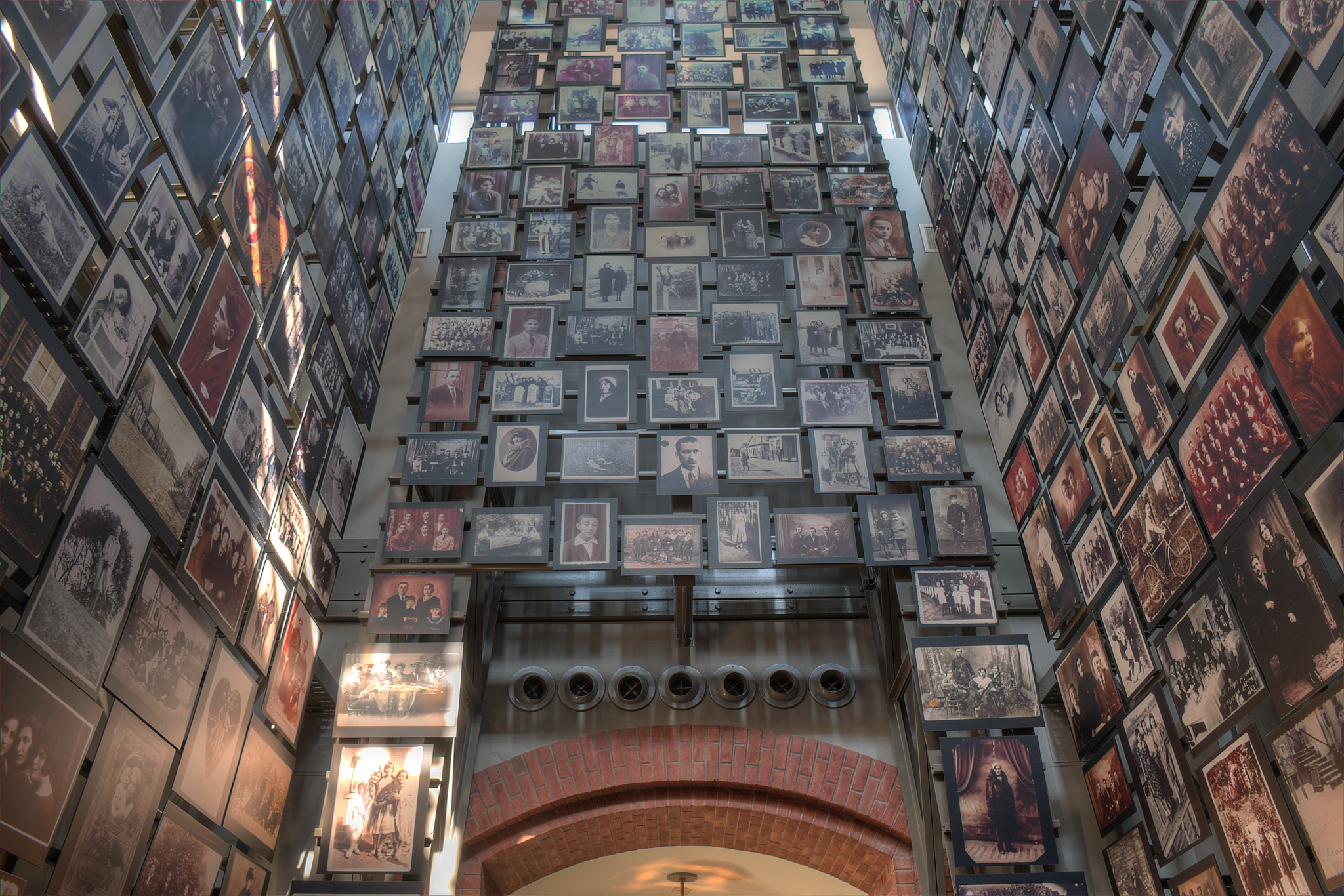
PHOTO: The Tower of Faces—photographs of Holocaust victims—at the United States Holocaust Memorial Museum, Washington, DC. Photo by D.S. Dugan, used by permission.

holocaust museum 1 copy

NOTE: The United States Holocaust Memorial Museum (USHMM) is the United States’ official memorial to the Holocaust. On Nov. 1, 1978, U.S. President Jimmy Carter established the President’s Commission on the Holocaust, chaired by Elie Wiesel, a prominent author, activist, and Holocaust survivor. Its mandate was to investigate the creation and maintenance of a memorial to victims of the Holocaust and an appropriate annual commemoration to them. On September 27, 1979, the Commission recommended the establishment of a national Holocaust memorial museum in Washington, DC.  Nearly $190 million was raised from private sources for building design, artifact acquisition, and exhibition creation. In October 1988, President Ronald Reagan helped lay the cornerstone of the building, designed by architect James Ingo Freed. Dedication ceremonies on April 22, 1993 included speeches by U.S. President Bill Clinton, Israeli President Chaim Herzog, and Elie Wiesel. On April 26, 1993, the Museum opened to the general public. Its first visitor was the 14th Dalai Lama of Tibet.

PHOTO: The U.S. Holocaust Memorial Museum, Washington DC, with the Washington Monument visible on the right. Photo by Timothy Hursley for the U.S. Holocaust Memorial Museum.

NOTE FROM THE AUTHOR: When my family visited the United States Holocaust Memorial Museum in Washington DC a few years ago, I felt like I was walking in the shadow of my grandmother, whose  parents and siblings had been murdered by the Nazis. They were trapped in a world of hatred, where Jews suffered, were punished, and died for being Jewish. This haunts me even more now, as we see an escalation in this country of anti-Semitism, racism, and every other form of hatred that results in despair and death. I left the museum after about three hours. It has never left me.

blankman

ABOUT THE AUTHOR: Shelly Blankman and her husband are empty nesters who live in Columbia, Maryland, with their three cat rescues and one dog. They have two sons— Richard, 36, of New York, and Joshua, 34, of San Antonio, Texas. Shelly’s first love has always been poetry, although her career has generally followed the path of public relations/ journalism. Her poetry has been published by First Literary Review, Verse-Virtual,  and The Ekphrastic Review among other publications. Recently, Richard and Joshua surprised her by publishing a book of her poetry, Pumpkinheadnow available on Amazon.

Kalimpong With Mother and Father by Amrita Valan

india roth licensed

Kalimpong With Mother and Father
by Amrita Valan

It was the bedrock June of my nineteenth year
Traveling by train to Kalimpong, peaceful pristine
Poor cousin of crowded Darjeeling.

Stayed at an old Colonial guesthouse, a charming
Red roofed bungalow of deep cream. Dark
Polished wooden floors and red tiles in the front.
A breath of fresh morning, Kanchenjunga. With tea
And hot buttered toast. Mother’s face unlined itself
As she took on the glow of radiance borrowing
Sunrise on Kanchenjunga.
Me, I watched both in wonder as I fed the obligatory
Guest house pet golden spaniel, bits of buttered bread.
Then long winding uphill walks till breath came in rasps.
Turn around and run downhill like a little girl
Mother following sedate.
I reach the red wrought iron gates of Anne Villa
Lovely British legacy of cool summers spent on
Hill stations, a rhythm of the forgotten past
Recalled. Like the melody of my parents poem
Which stopped midway. As ma did now. And
Much later, leaving father a widower. But now,
She paused to let my tall shawl-clad father catch
Up with her.
Haze of morning mist playing still on their faces
End of journey and destinations unknown, in my
Sweet temporal travelogue.

© Amrita Valan 2020

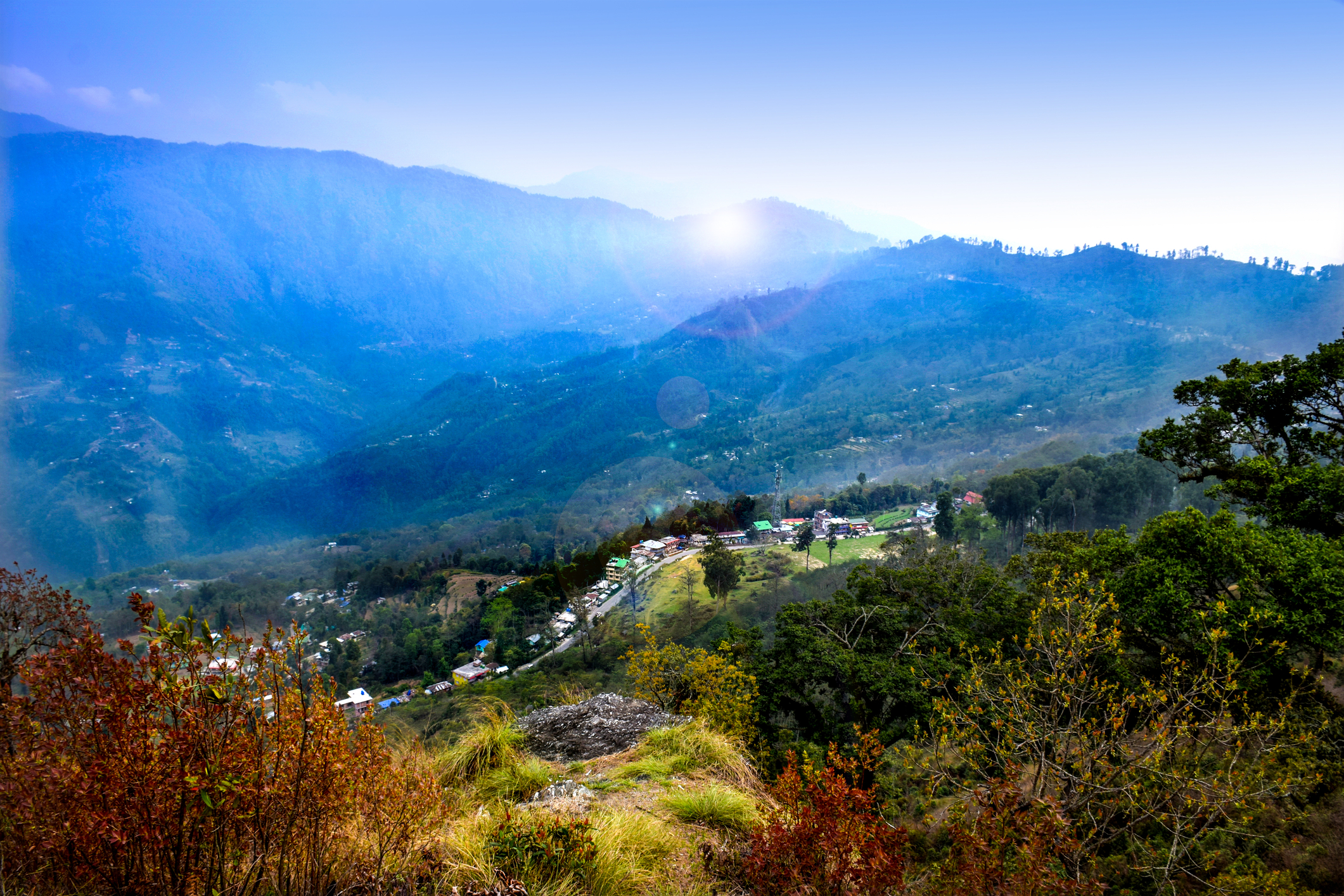
PHOTO: View of Pedong in Kalimpong district of West Bengal, India. The town is located on a ridge that offers a panoramic view of Kanchenujunga and the Himalayas. Photo by Sonali Basu Routh, used by permission.

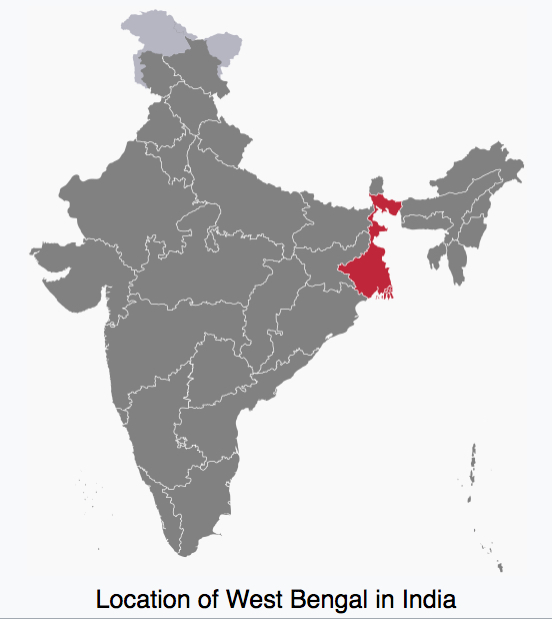
west bengal

NOTE: Kalimpong is a town and a municipality in the Indian state of West Bengal. The municipality sits on a ridge overlooking the Teesta River and is a tourist destination owing to its temperate climate, natural environment, and proximity to popular tourist locations in the region.  West Bengal borders Bangladesh to the east, and Nepal and Bhutan to the north.

valan

ABOUT THE AUTHOR: Amrita Valan holds a master’s degree in English literature, and has written over a thousand poems on love, spirituality, family, religion, current affairs, and human rights. She has also written short stories, rhymes, and tales for children. Published in several anthologies, 18 of her poems were recently featured in online zines. She lives in India, and is the mother of two boys. 

Revisiting Joshua Tree National Park by Carolyn Martin

joshua-tree-841335_1920

Revisiting Joshua Tree National Park
Twentynine Palms, California
by Carolyn Martin

Joshua fit the battle of Jericho
And the walls come tumblin’ down . . .
        — An African-American spiritual

The terrain hasn’t changed. The Cap still tilts.
The Skull glares over a parking lot.
The Jumbo Rocks? This careless pile nudged
from eons underground lazes in the sun.
It’s spring this drive around
and creamy-white bells stun
every limb of every namesake tree.

A million yuccas ring like ram horns
tumbling Canaan’s walls, stretching
spiky arms above the rocky seas,
parting lands promising for rabbits,
lizards, red-tailed hawks, and cactus wrens;
for natives, ranchers, miners, campers, climbers
dazed by heat and snow and spiraling stars
the Milky Way enfolds.

If Joshua only knew his name
would bloom across 1200 miles squared,
he might not have died despondent and alone.
His, the pride of place right here — above dunes
and valleys and monuments wind-shaped —
where water finds a way through desert faults
without a fight, without a second thought.

Previously published in the author’s collection Thin Places (Kelsay Books, 2017).

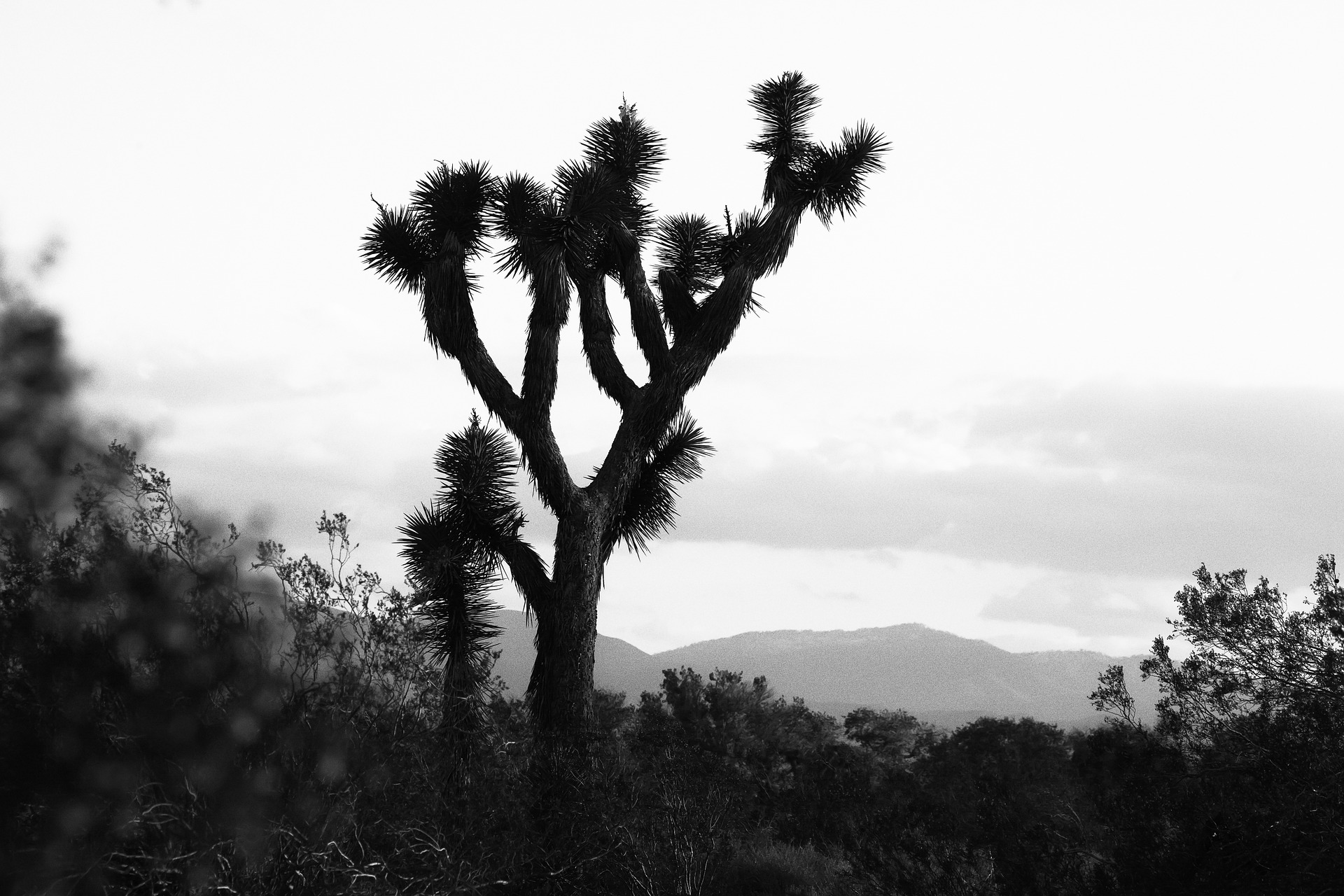
PHOTO: Joshua Tree in Joshua Tree National Park, Mojave Desert, California. Joshua Trees are native to the Mojave Desert, thriving in the open grasslands of Queen Valley and Lost Horse Valley in Joshua Tree National Park. Photo by Jay George, used by permission. 

Joshua Tree

NOTE: Joshua Tree National Park is located in southeastern California, east of Los Angeles, near Palm Springs. It is named for the Joshua trees native to the Mojave Desert. Originally declared a national monument in 1936, Joshua Tree was redesignated as a national park in 1994 when the U.S. Congress passed the California Desert Protection Act. Encompassing a total of 790,636 acres (1,235.4 square miles), the park consists of 429,690 acres (671.4 square miles) of designated wilderness. The park includes parts of two deserts, each an ecosystem with characteristics determined primarily by elevation: the higher Mojave Desert and the lower Colorado Desert. The Little San Bernardino Mountains traverse the southwest edge of the park. For a virtual tour, visit nps.gov. 

PHOTO: Joshua Tree National Park, California, with blooming Joshua Trees. Photo by the author. 

NOTE FROM THE AUTHOR: On this return to Joshua Tree in March 2016, we were privileged to see the big “creamy white bells” blooming on the trees. An unexpected treat!

Carolyn Martin

ABOUT THE AUTHOR: From associate professor of English to management trainer to retiree, Carolyn Martin is a lover of gardening and snorkeling, feral cats and backyard birds, writing and photography. Her poems have appeared in more than 125 journals throughout North America, Australia, and the UK. Her first chapbook, Nothing More to Lose, and her fifth poetry collection, The Catalog of Small Contentments, will be released by The Poetry Box in 2021. She is the poetry editor of Kosmos Quarterlyjournal for global transformation. Find out more at carolynmartinpoet.com

The Writer by Robert Lima

scotland fokoton licensed

The Writer
by Robert Lima

Backed by nebulous nature,
under forged matrix spirals
from which a path is said to spring,
his silhouetted image sits mid-air
with plumed pen pending in his hand,
looming over the Victorian desk,
whose bowed legs are in symbiosis
with the arching of his back.
It could be Stevenson or Burns or Scott
who, quill in hand, sat for the sign,
stilled in the thought of capture
of that great idea, plot or verse,
or, in generic anonymity,
not one of them at all.

The lantern on the wall
that hangs below whoever’s ken
is dark against the still-bright day,
expecting the lamplighter’s tread,
its vacant hold awaiting
its deliverance by flame.

PHOTO: The Writers’ Museum, Edinburgh, Scotland. Photo by Fotokon, used by permission.

NOTE: The Writers’ Museum celebrates the lives of three giants of Scottish Literature– Robert Burns, Sir Walter Scott, and Robert Louis Stevenson. Home to portraits, rare books, and personal objects, including Burns’ writing desk, the printing press on which Scott’s Waverley Novels were first produced, and the rocking horse he used as a child. The collection also features Robert Louis Stevenson’s riding boots and the ring given to him by a Samoan chief, engraved with the name “Tusitala,” meaning teller of tales,” as well as a plaster cast of Robert Burns’ skull, one of only three ever made. Items of note also include a chair used by Burns to correct proofs at William Smellie’s printing office, and Stevenson’s cabinet made by the infamous Deacon Brodie whose double life may have inspired the novel The Strange Case of Dr Jekyll and Mr Hyde.

adli-wahid-9XDxyDyB_RM-unsplash

edinburgh, scotland map

NOTE: Edinburgh is the capital of Scotland and the seat of the Scottish Government, the Scottish Parliament and the Supreme Courts of Scotland. It is the second largest financial center in the United Kingdom (after London), and the city’s historical and cultural attractions have made it the United Kingdom’s second most visited tourist destination, attracting 4.9 million visits including 2.4 million from overseas in 2018. The official population estimates are 518,500 (mid-2019) for the City of Edinburgh council area and 1,339,380 (2014) for the wider city region. Edinburgh is home to national cultural institutions such as the National Museum of Scotland, the National Library of Scotland, and the Scottish National Gallery.

PHOTO: Edinburgh, Scotland, with Edinburgh Castle in the background. Photo by Adli Wahid on Unsplash

NOTE FROM THE AUTHOR: “The Writer” is based on my visits to The Writers’ Museum in Edinburgh, Scotland, on several occasions, and being taken each time by the sign and its locale.

2016-POSE3

ABOUT THE AUTHOR: Robert Lima is a Cuban-born award-winning poet, and an internationally recognized critic, bibliographer, playwright, and translator. As a Greenwich Village poet during the 1960s, he read at coffeehouses and other venues, co-edited Seventh Street: Poems of Les Deux Megots, introduced by Denise Levertov, and the second series of Judson Review. His 15 poetry collections include Celestials, ElementalsSardinia/SardegnaIkons of the Past. Poetry of the Hispanic Americas and Writers on My Watch (2020). Over 600 of his poems have appeared in print in the U.S. and abroad. Eleven of his poems have just appeared in Greek translation in Noima Magazine. Among his numerous critical studies are works on García Lorca, Valle-Inclán, Borges, Surrealism, folklore, dramatic literature, and translations of plays and poetry.

Golden Gate Morning by Marianne Brems

Golden Gatesydney-herron-pVAzPGYy3NE-unsplash

Golden Gate Morning
by Marianne Brems

Fog spills over the ridge like a cauldron.
Thick and soft as goose feathers,
swaddling a bridge
not ready to rise from sleep
beneath its hidden towers.
The majestic turned docile
inside a shroud of gray.

But within seconds,
like an apology for obstruction,
the north tower leaps through this curtain
in a sudden blaze of crimson
piercing the lucid azure sky.
Persistent wisps of fog
timidly seep over the ridge
but can no longer contain
a paramount cool sunlight.

First published in Sliver of Change (released November 26, 2020 by Finishing Line Press).

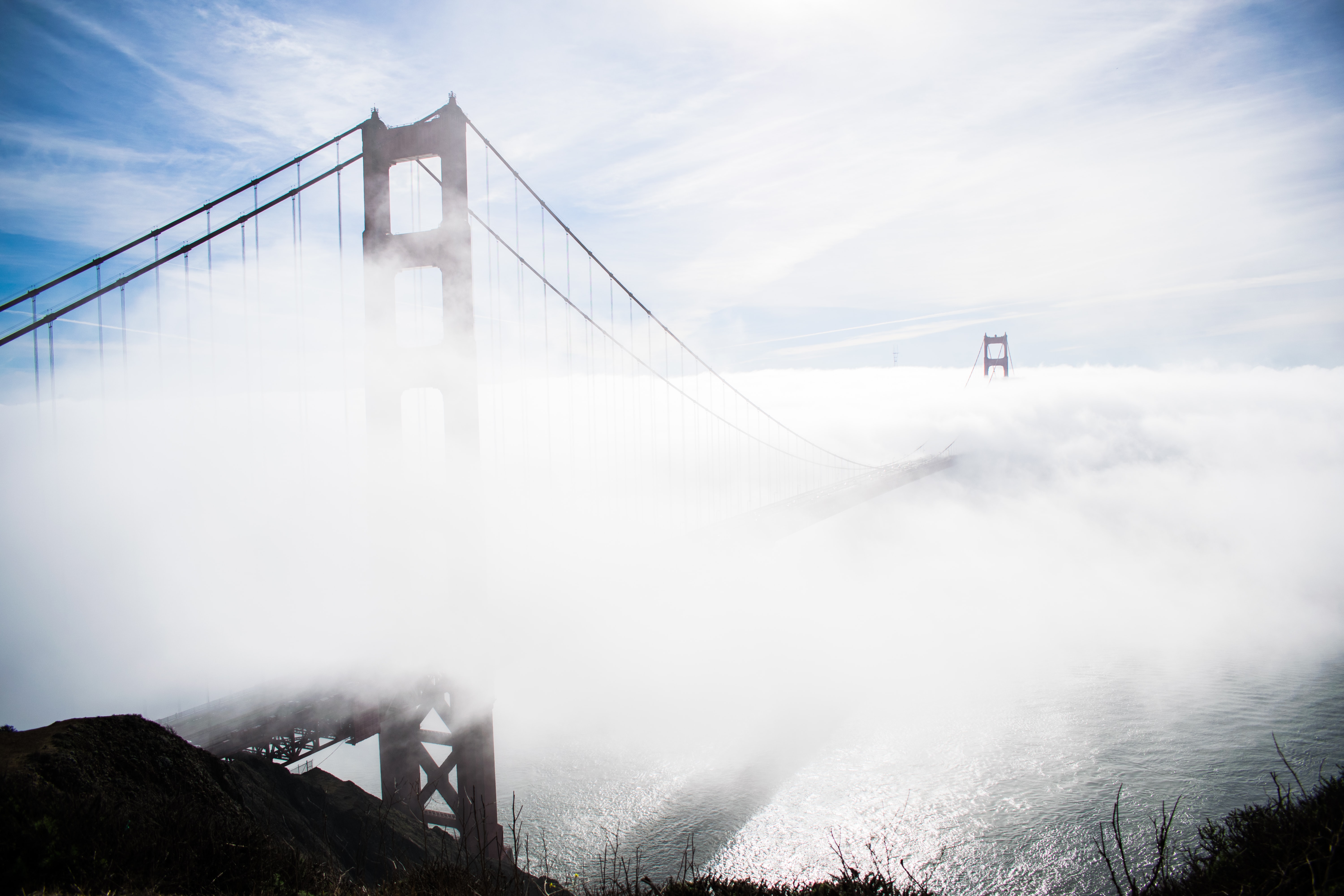
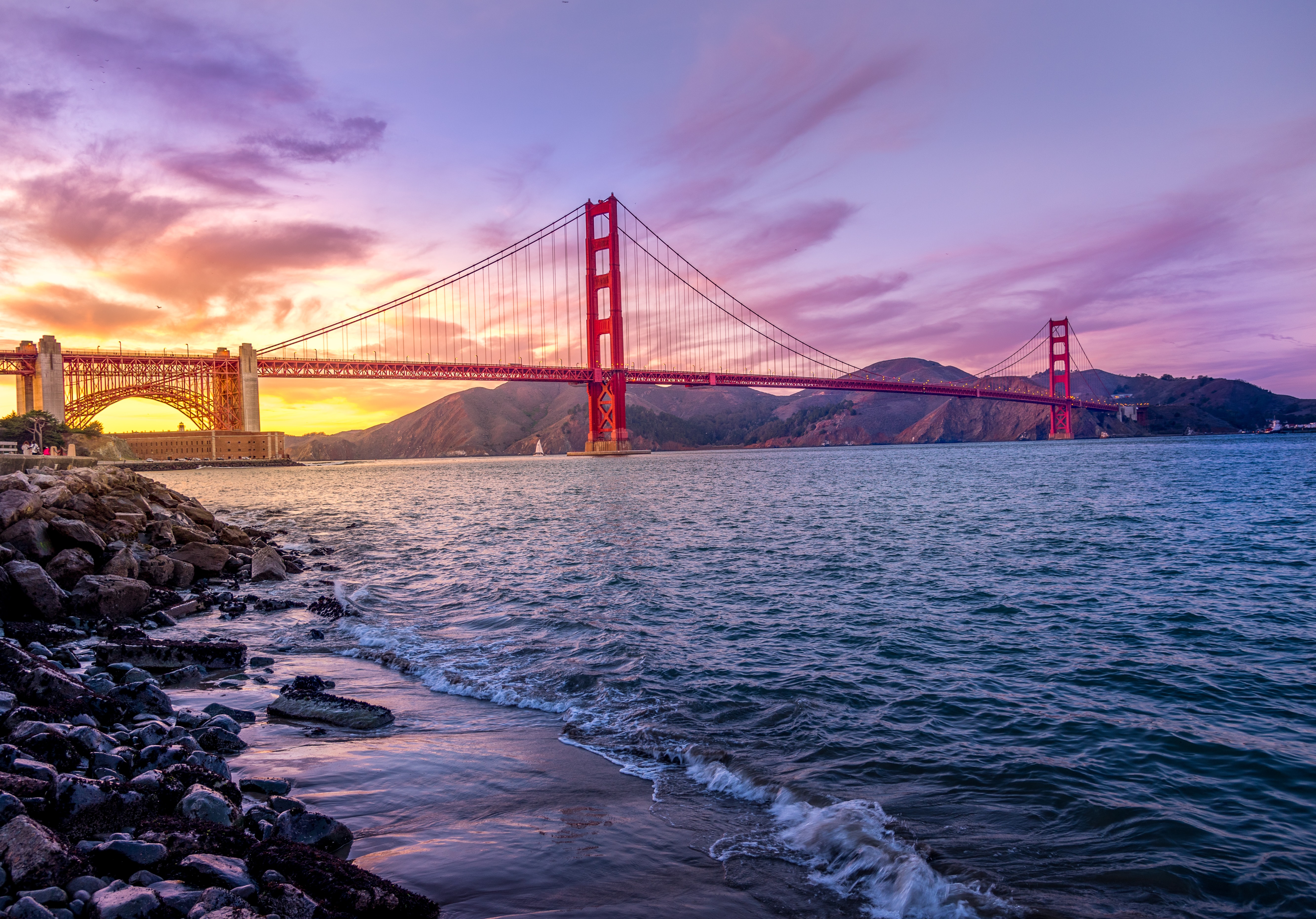
PHOTO: The Golden Gate Bridge in morning fog, San Francisco, California. Photo by Sydney Herron on Unsplash.

umer-sayyam-SHP1t8EduMY-unsplash

NOTE: The Golden Gate Bridge spans the Golden Gate, the one-mile-wide strait connecting San Francisco Bay and the Pacific Ocean. The structure links San Francisco—the northern tip of the San Francisco Peninsula—to Marin County, carrying both U.S. Route 101 and  California State Route 1 across the strait. Designed in 1917 by engineer Joseph Strauss, and completed by other architects and engineers, it has been declared one of the Wonders of the Modern World by the American Society of Civil Engineers. The Frommer’s travel guide describes the Golden Gate Bridge as “possibly the most beautiful, certainly the most photographed, bridge in the world.” At the time of its opening in 1937, it was both the longest and the tallest suspension bridge in the world, with a main span of 4,200 feet and a total height of 746 feet.

PHOTO: The Golden Gate Bridge at sunset (San Francisco, California). Photo by Umer Sayyam on Unsplash

NOTE FROM THE AUTHOR: I drove across the Golden Gate Bridge in May 2016.

IMG_0434

ABOUT THE AUTHOR: Marianne Brems’ first poetry chapbook is Sliver of Change (Finishing Line Press, 2020). Her second chapbook Unsung Offerings is forthcoming in 2021. Her poems have appeared in literary journals, including The Pangolin Review, Nightingale & Sparrow, The Sunlight Press, and The Tiny Seed Literary Journal. She lives in Northern California. Visit her at mariannebrems.com.

Insect Life of Florida by Lynda Hull

florida jaimie tuchman licensed

Insect Life of Florida
by Lynda Hull

In those days I thought their endless thrum
    was the great wheel that turned the days, the nights.
       In the throats of hibiscus and oleander

I’d see them clustered yellow, blue, their shells
     enameled hard as the sky before the rain.
       All that summer, my second, from city

to city my young father drove the black coupe
     through humid mornings I’d wake to like fever
       parceled between luggage and sample goods.

Afternoons, showers drummed the roof,
     my parents silent for hours. Even then I knew
       something of love was cruel, was distant.

Mother leaned over the seat to me, the orchid
     Father’d pinned in her hair shriveled
       to a purple fist. A necklace of shells

coiled her throat, moving a little as she
     murmured of alligators that float the rivers
       able to swallow a child whole, of mosquitoes

whose bite would make you sleep a thousand years.
     And always the trance of blacktop shimmering
       through swamps with names like incantations—

Okeefenokee, where Father held my hand
     and pointed to an egret’s flight unfolding
       white above swamp reeds that sang with insects

until I was lost, until I was part
     of the singing, their thousand wings gauze
       on my body, tattooing my skin.

Father rocked me later by the water,
     the motel balcony, singing calypso
       with the Jamaican radio. The lyrics

a net over the sea, its lesson
     of desire and repetition. Lizards flashed
       over his shoes, over the rail

where the citronella burned merging our
     shadows—Father’s face floating over mine
       in the black changing sound

of night, the enormous Florida night,
     metallic with cicadas, musical
       and dangerous as the human heart.

SOURCE: Collected Poems by Lynda Hull (Graywolf Press, 2006). Copyright © 2006 by the Estate of Lynda Hull. Used by permission of Graywolf Press, Saint Paul, Minnesota, graywolfpress.org.

PHOTO: Egrets in the Okefenokee Swamp, Florida. Photo by Jaimie Tuchman, used by permission. 

florida brian lasenby licensed

NOTE: The Okefenokee Swamp is a shallow, 438,000-acre peat-filled wetland straddling the Georgia-Florida line in the United States. A majority of the swamp is protected by the Okefenokee National Wildlife Refuge and the Okefenokee Wilderness. Considered one of the Seven Natural Wonders of Georgia, the Okefenokee is the largest blackwater swamp in North America. The swamp, which was designated a National Natural Landmark in 1974, is home to many wading birds, including herons, egrets, ibises, cranes, and bitterns. Okefenokee is famous for its amphibians and reptiles such as toads, frogs, turtles, lizards, snakes, and an abundance of American alligators

PHOTO: American Alligator on the banks of the Suwannee River in the Okefenokee Swamp Wildlife Refuge, Georgia. Photo by Brian Lasenby, used by permission. 

lynda hull 1

ABOUT THE AUTHOR: Lynda Hull was born in Newark, New Jersey, in 1954. Her collections include Ghost Money (1986), recipient of the Juniper Prize; Star Ledger (1991), which won the 1991 Carl Sandburg and 1990 Edwin Ford Piper awards; and The Only World: Poems, published posthumously in 1995 and finalist for the National Book Critics Circle Award in Poetry. In 2006, Graywolf Press published her Collected Poems, edited by her husband, David Wojahn. Hull was the recipient of four Pushcart Prizes as well as fellowships from the National Endowment for the Arts and the Illinois Arts Council. In addition to serving as the poetry editor for the journal Crazyhorse, she taught English at Indiana University, DePaul University, and Vermont College. In 1994, she died at age 49 in a car accident.

Author photo by Michael Twombley

French Postcards by Andrena Zawinski

Rooftop_Hideout

French Postcards
by Andrena Zawinski

1.

This picture is for you
of the café where I rested
on the long walk
from Tour Eiffel to Notre Dame,
and here is another
of the Louvre, with a view
from the other side of the river.

Tonight, nibbling at the last
of the boulanger’s stiff baguette
and overripe cheese, I have to tell you
this red wine must be finally
getting to my head,
because I find myself alone
and scribbling in the dark
in Paris.

2.

Dear,
the hotel generator has failed,
midnight again.

At the window of this blackened
walkup, above the sax and scooter
skittering St. Catherine’s Square,
there is across the walk a light
on the bright white tile
of someone’s kitchen wall,
a dozen limpheaded roses
on the sink, plates and glasses
left neatly coupled
at the drain. It is the two of them
I think I see below, arm in arm,
moving along the cobblestone walkway
through the shadowed narrow,
their backs toward me.

3.

As I’m scribbling in this dark,
I am trying to place
where is the cache of maps, carnets
of tickets to take me
where it is I will go next. Afraid,
without speech
in Paris, I weight thin French
with pauperish smiles
I try on, like grande dames
do hats in chic boutiques
inside Le Marais.

(Only the once, when I was not afraid
and dared a brief American skirt
with just English, was I mistaken for
Irma La Douce in Bois de Boulogne.)

4.

Now that the lampe hums, flickers
a promise of light,
Vivaldi swims up from the square
on strings of guitare, July, rain,
on the splash
of wheels spinning the street.

Everyone else seems to know
where it is
they are going.

And me, at least
I have traveled here.
Amour,
I have made it
from Pittsburgh
to Paris,
alone.

SOURCE: Pittsburgh Post Gazette, “Poet’s Corner” (A-7), June 3, 1995, Pittsburgh, Pennsylvania. Also appears in the author’s collection Traveling in Reflected Light.

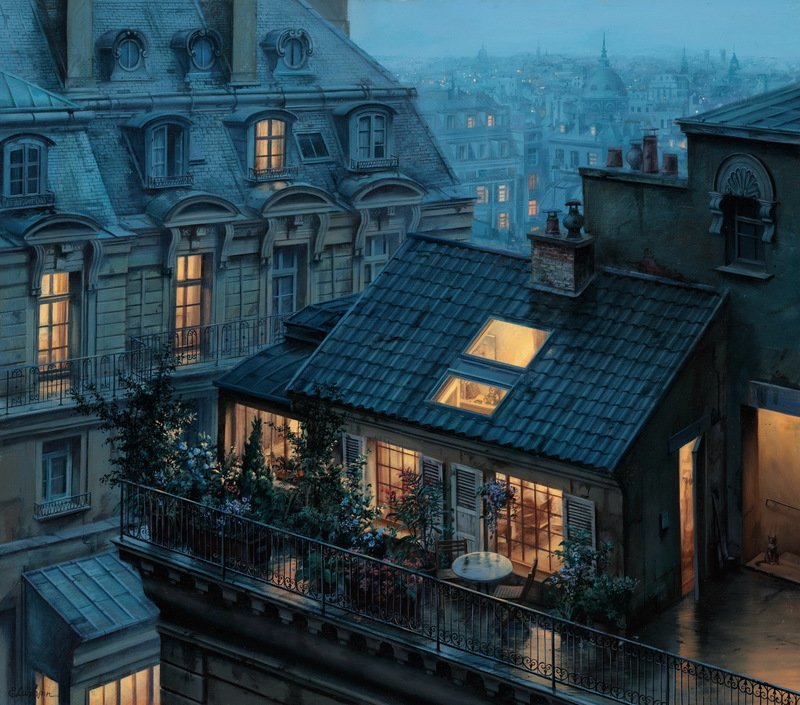
IMAGE: Rooftop Hideout © Evgeny Lushpin. Original painting and reproductions available at lushpin.com. Learn more about the artist and his work at mymodermet.com.

NOTE FROM THE AUTHOR: Many years ago I braved a trip to Paris alone after being part of a University of Pittsburgh Teacher Writers Project for three weeks in London. Impulsively, with a Poor Man’s Guide to Paris a friend gave me, I walked into a travel agency and booked a flight that same afternoon. Who doesn’t dream of a trip to Paris who has never been? And who wouldn’t be surprised there by power outages in the City of Light? The fifth-floor window in the room I had rented, having a bit of dinner at the window, was the perfect place for an eavesdropper like me. There I began “French Postcards” as an actual postcard. The rest emerged once the lights came back on, absorbing some of the unexpected on that journey. When I saw Rooftop Hideout by Evgeny Lushpin (above) on an internet site, I was  struck by the painting because I could swear that’s the window where I wrote the poem “French Postcards.”

zawinski3

ABOUT THE AUTHOR: Andrena Zawinski’s poetry has received numerous awards for lyricism, form, spirituality, and social concern, with several receiving Pushcart Prize nominations. Her latest book is Landings from Kelsay Books; others are Something About from Blue Light Press (a PEN Oakland Award) and Traveling in Reflected Light from Pig Iron Press (a Kenneth Patchen Prize), along with several chapbooks. She is a veteran teacher of writing and activist poet who founded and runs the San Francisco Bay Area Women’s Poetry Salon and is Features Editor at PoetryMagazine.com.

lushpin e copy

ABOUT THE ARTIST: Born in 1966 not far from Moscow, Evgeny Lushpin was apprenticed in Russia’s finest schools. His work is based on endless travel across channels of old cozy towns and long avenues of world famous cities. He endeavors to capture stunning moments and show more than meets the eye. The play of light and dark, rich palettes of color, and hundreds of subtle details work together to  create a symphony of power and light. His style is widely recognized and his work attracts collectors from all over the world. He says, “It’s a different state of mind with each painting, but I always completely immerse myself into the time, place, and subject of my art.”