Pandemic Escapees by Leah Mueller

jt inn 4

Pandemic Escapees
by Leah Mueller

Lying in our motel bed
halfway between
Washington and Arizona:

fitful crossroads
of a dirty central
California town.

Steinbeck country
minus the romance.

Days Inn of Westley,
ground-floor room
with a parking lot view,
68 dollars plus tax.

I shove my ears tight
against the pillows
to stifle the endless
rumble of semis.

Dreams punctuated
by the frantic
shriek of brakes
and the sudden roar
of acceleration.

Truckers can’t
afford to rest,
and neither can we.

Tomorrow night,
the two of us
will reach Joshua Tree
and sleep in the room
where Gram Parsons died.

In the morning,
we’ll have breakfast
on the patio, seated alone
in gritty iron chairs

beside the artificial
blue shimmer
of a swimming pool:

your gaunt cheeks pale
as you scoop food
from its Styrofoam wrappings.

So far to drive until
the desert appears.

So much in the
rearview mirror, getting
smaller by the second.

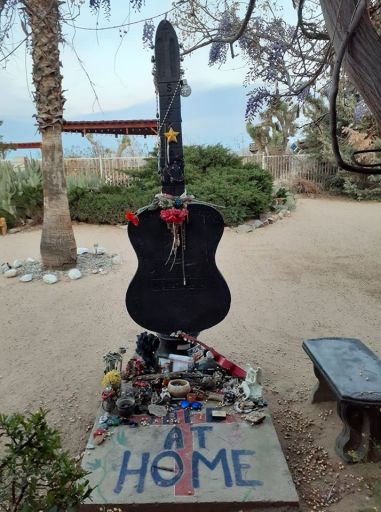
PHOTO: Joshua Tree Inn, 61259 Twentynine Palms Highway, Joshua Tree, California, 92252 — located in the Mojave DesertRoom 8 honors singer/songwriter/musician Gram Parsons, who died there on September 19, 1973 at age 26. (Photo from the Joshua Tree Inn website.)
gram

NOTE FROM THE AUTHOR: “Pandemic Escapees” concerns a recent road trip I took with my husband when we moved from Tacoma, Washington, to Bisbee, Arizona, at the onset of the pandemic. It was a most depressing and surreal time, but it yielded an unexpected benefit. The Joshua Tree Hotel, where Gram Parsons drew his last breaths, was completely empty, and I got to realize a long-time dream of spending the night in his room.

PHOTO: Gram Parsons memorial at Joshua Tree Inn. Photo by Leah Mueller.

mueller2-copy

ABOUT THE AUTHOR: Leah Mueller is an indie writer and spoken word performer from Bisbee, Arizona. Her most recent books, Misguided Behavior, Tales of Poor Life Choices (Czykmate Press), Death and Heartbreak (Weasel Press), and Cocktails at Denny’s (Alien Buddha Press) were released in 2019. Leah’s work appears in Midway Journal, Citron Review, The Spectacle, Miracle Monocle, Outlook Springs, Atticus Review, Your Impossible Voice, and other publications. Her essay, “Firebrand, The Radical Life and Times of Annie Besant,” is featured in the book, Fierce, Essays By and About Dauntless Women, which placed first in the nonfiction division of the 2019 Publisher’s Weekly Booklife contest. Visit her on Instagram and Twitter.

Overnight at White Pocket by Cynthia Anderson

White Pocket Reflection photo by Bill Dahl

Overnight at White Pocket
by Cynthia Anderson

You sleep if you can, a blanket
of cold stars pulled over your head—

then rise before dawn to catch
the first rays lighting those pale

and painted rocks—swirled concretions
of bygone dunes, shaped by wind

and snow and rain, like the storm
that blew in yesterday, casting

kaleidoscopes of shadow and sun
over gnarled domes and ridges,

a few black cattle passing through—
caught in geologic time, you watch

waves of sandstone ebb and flow
until you’re submerged among

the moqui marbles—
wherever your breath has gone,

you’re not the same as when you came.

PHOTO: “White Pocket Reflection” by Bill Dahl, used by permission.

NOTE: Vermilion Cliffs National Monument is located in northern Arizona, immediately south of the Utah state line.  The Vermilion Cliffs are steep eroded escarpments consisting primarily of sandstone, siltstone, limestone, and shale that rise as much as 3,000 feet above their bases. These sedimentary rocks have been eroded for millions of years, exposing hundreds of layers of richly colored rock strata. Mesas, buttes, and large tablelands are interspersed with steep canyons, where small streams provide enough moisture to support a sampling of wildlife.

White Pocket Rocks photo by Bill Dahl

NOTE FROM THE AUTHOR: White Pocket is a remote, jaw-droppingly scenic destination in the Vermilion Cliffs National Monument, known for its spectacular rock formations. In May 2017, my husband, Bill Dahl, and I took an overnight guided camping tour to the spot. We were glad we made that choice, as we’re quite sure we never could have found it on our own, much less navigated the 35+ miles of unmarked, backcountry “roads” (really, tracks of deep sand) to get there. Though it was mid-May, we were greeted by blowing snow and overnight temperatures in the twenties. Nevertheless, we stayed out until dark and were up again at dawn to spend every possible minute exploring and photographing. The only people there were those in our small group. The utter silence, solitude, and natural beauty were unsurpassed. The poem refers to “moqui marbles.” These are small, roundish rocks composed of iron oxide and sandstone, plentiful at White Pocket. We did not take moqui marbles from the site.

PHOTO: “White Pocket Rocks” by Bill Dahl, used by permission.

Cynthia Anderson and Bill Dahl

ABOUT THE AUTHOR: Cynthia Anderson lives in the Mojave Desert near Joshua Tree National Park. A Pushcart Prize and Best of the Net nominee, she has published nine poetry collections, most recently Now Voyager with illustrations by Susan Abbott. She is co-editor of the anthology A Bird Black As the Sun: California Poets on Crows & Ravens and guest editor of Cholla Needles 46, both available at amazon.com. Visit her at www.cynthiaandersonpoet.com

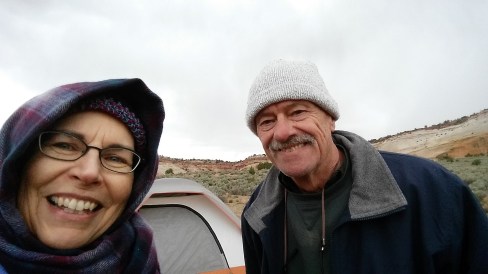
PHOTO: Cynthia Anderson and Bill Dahl at White Pocket, Vermilion Cliffs National Monument, Coconino County, Arizona.

Ocracoke Night Magic by Ann Christine Tabaka

Ocracoke Night Magic
by Ann Christine Tabaka

Night falls early on the island with no pollution from light
to interfere. The blackest of black. The only illumination
a diamond-studded firmament, with a brilliant pathway
dividing it in two. The Milky Way is visible arching
northeast to southwest. A magical experience standing on
windswept beach. Salt breezes waft inland from the ocean.
Many a crystal night shooting stars dance across the sky,
carrying wishes as they vanish in a wink. Moonlight
flickering off the surface as the sea rises and falls with each
breath. Froth caressing the edges in lacy patterns reflecting
the lunar effluence. The sound of waves crashing on the
shore echo through the ebon night, as an eerie wind whistles
through the marsh grass, conjuring up images of long-lost
souls. Ghosts of pirates that once made Ocracoke Island
their stronghold, walk there still. Emotions rising with each
heartbeat, a flight of wonderment takes hold. Warm moist sand
creeps between my toes as I walk along the dunes. I can
stand there forever looking upward at the magic that enfolds
me. A place of wonder and delight takes my imagination
to some unknown place from where I may never return.
The night was meant for this.

Previously published by TreeHouse Arts (November 2018).

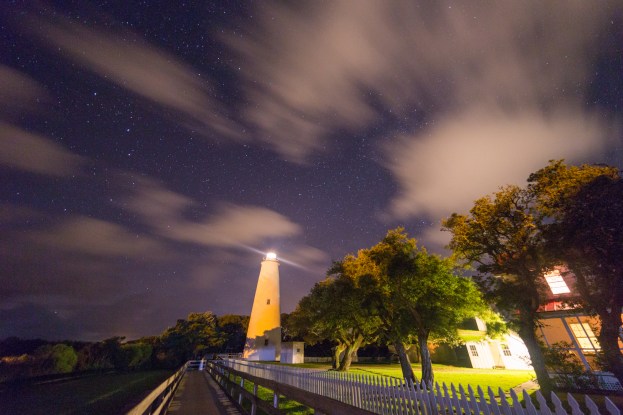
PHOTO: Low clouds pass over a star-filled sky behind the Ocracoke Lighthouse on Ocracoke Island, Outer Banks, North Carolina. Photo by Matt Claiborne, used by permission. Read more about Ocracoke Island at TravelandLeisure.com.

NOTE FROM THE AUTHOR: My husband and I have been visiting Ocracoke Island, North Carolina, for 26 years. We consider it our “home away from home.” The autumn nights are amazing with innumerable stars and the Milky Way visible. We love to go to the quiet beach after dark and watch for shooting stars to wish upon. It is a magical place with so much history and lure.

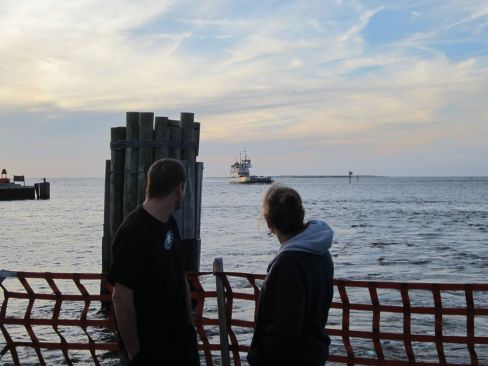
AUTHOR’S PHOTO CAPTION: With my son Damon on the ferry crossing from Hatteras Island to Ocracoke Island, North Carolina.

ABOUT THE AUTHOR: Ann Christine Tabaka was nominated for the 2017 Pushcart Prize in Poetry. She is the winner of Spillwords Press 2020 Publication of the Year, and her bio is featured in the “Who’s Who of Emerging Writers 2020,” published by Sweetycat Press. Internationally published, she has won poetry awards from numerous publications. Her work has been translated into Sequoyah-Cherokee Syllabics and into Spanish. She is the author of 12 poetry books and has recently been published in several micro-fiction anthologies and short story publications.  A resident of Delaware, where she lives with her husband and four cats, she loves gardening and cooking. Her most recent credits are The American Writers Review; The Phoenix; Burningword Literary Journal; Muddy River Poetry Review; The Write Connection; The Scribe, North of Oxford, Pomona Valley Review, Page & Spine, West Texas Literary Review, The Hungry Chimera, Sheila-Na-Gig, Foliate Oak Review, The Stray Branch, The McKinley Review, and Fourth & Sycamore. Visit her at annchristinetabaka.com and on her Amazon author’s page.

Slip Over the Edge by Ken Hartke

OLYMPUS DIGITAL CAMERA

Slip Over the Edge
by Ken Hartke

Quietly slip over the edge.
Disappear without a trace.
Follow the old trails.
The canyon trails are worn smooth
by bare feet or reed sandals.
Centuries old handholds are still there.

Trails wind down to hidden pools.
Deep shade is cool below the canyon rim
Scorching sunlight is a stranger here.
The breeze builds toward the afternoon.
Channeled up the narrow canyon.
It’s cool among the willows.

A dove bathes in the shallow stream.
A hummingbird hovers for an instant
checking you out.
Time passes slowly down here.
Centuries could skip by unobserved,
quietly slipping over the edge.

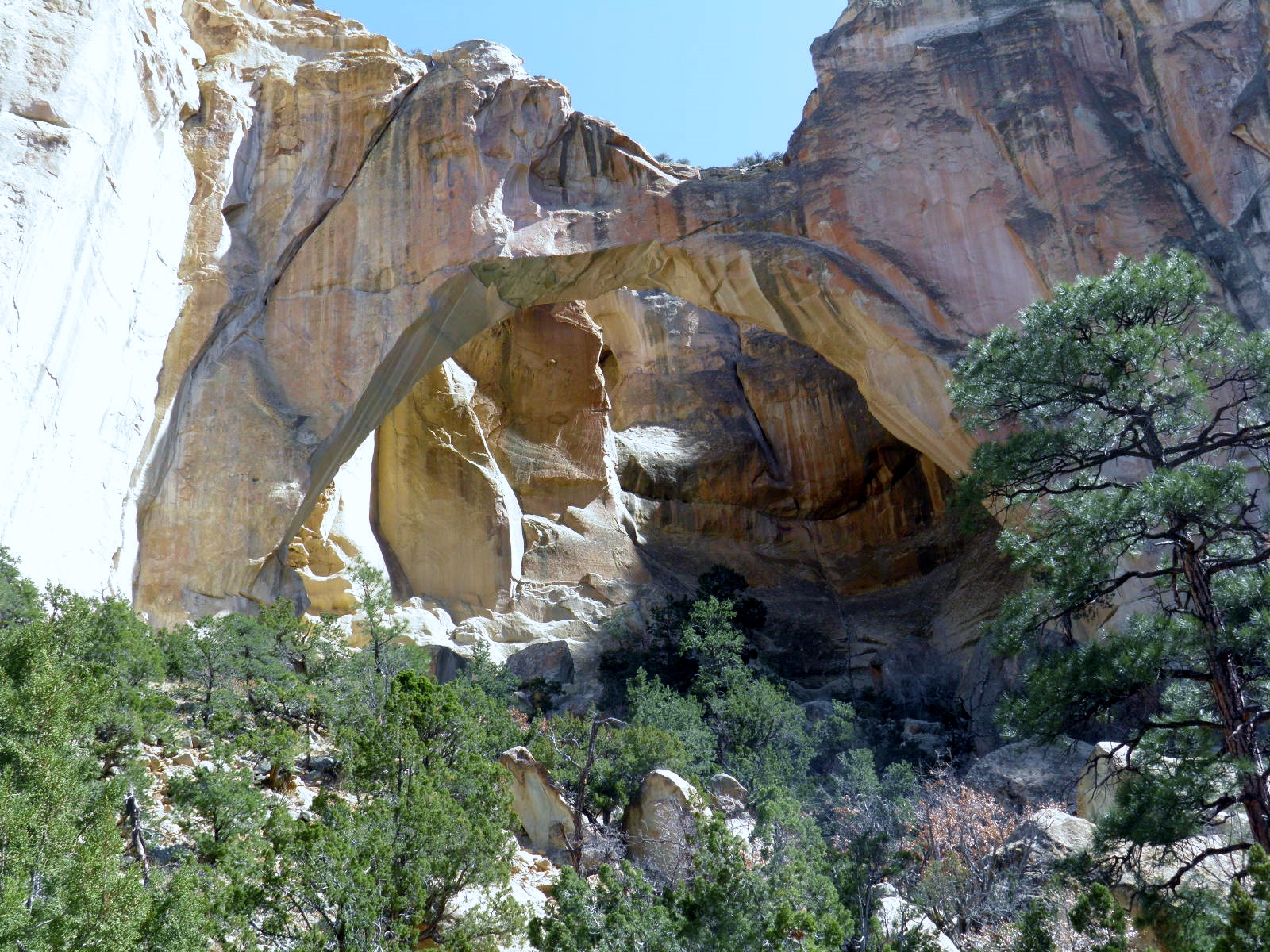
PHOTO: La Ventana, El Malpais National Conservation Area, near Grants, New Mexico. Photo by Ken Hartke, used by permission.

NOTE FROM THE AUTHOR: The poem was inspired by the New Mexico canyon country, specifically the solitary arch called La Ventana in El Malpais National Conservation Area (BLM) near Grants, New Mexico. This site borders the land held by the Acoma Pueblo, perhaps the oldest occupied town in the United States, going back almost 1,000 years. The “Malpais” (Spanish for”badlands”) refers to a huge lava field covering the floor of the adjacent valley. The most recent eruptions were about 800 years ago, certainly witnessed by native hunters and farmers in the area.

hartke-3

 ABOUT THE AUTHOR: Ken Hartke is a writer and photographer from the Rio Grande Valley in New Mexico, but was originally planted and nourished in the Midwest’s big river valleys. Always a writer, his writing was mainly work-focused until he landed in New Mexico in 2013 seeking a new second act. The state has been very welcoming. His New Mexico photography now inspires much of his writing — and sometimes the other way around. The great backcountry continually offers itself as a subject. He has contributed work for the Late Orphan Project’s anthology, These Winter Months (The Backpack Press), Silver Birch Press, and Foliate Oak Literary Magazine. He keeps an active web presence on El Malpais.

Sequoia Sunrise by Mark A. Fisher

denys-nevozhai-63Znf38gnXk-unsplash

Sequoia Sunrise
by Mark A. Fisher

icicle
starlight
hanging down
through the silent
red giants
while the thumbnail moon
spills silver light
that pools in the meadows
and slowly seeps out
into the forest
’til the barest hints
of red in the eastern sky
makes the first bird begin to
drowsily sing, rousing chickaree
hidden high up in the trees
and answered by a woodpecker
beating beating beating out the rhythm
for the chorus building in a crescendo with the light

above this bright morning cacophony
the sequoias
listen

Previously published in Avocet Summer 2010

PHOTO: Sunset Campground, Kings Canyon National Park, Hume, California. Photo by Denys Nevozhai on Unsplash

517px-General_Sherman_Tree_2013

NOTE: Sequoia National Park was established on September 25, 1890 to protect 404,064 acres of forested mountainous terrain in Northern California. The park is notable for its giant sequoia trees, including the General Sherman tree, the largest tree on Earth by volume. The park’s giant sequoia forests are part of 202,430 acres of old-growth forests shared by Sequoia and Kings Canyon National Parks. The giant sequoia is the world’s most massive tree, and arguably the largest living organism on Earth. The largest giant sequoias are as tall as a 26-story building, and the width of their bases can exceed that of a city street.

PHOTO: The General Sherman tree in Sequoia National Park (Tulare County, California). With a height of 275 feet, a diameter of 25 feet, and an estimated age of 2,300–2,700 years, it is among the tallest, widest, and longest-lived of all trees on the planet. Photo by Tuxyso, used by permission. 

mark

ABOUT THE AUTHOR: Mark A. Fisher is a writer, poet, and playwright living in Tehachapi, California.  His poetry has appeared in riverbabble, Spectrum, Silver Blade, Penumbra, Lummox, and many other places. His first chapbook, drifter, is available from Amazon. His second, hour of lead, won the 2017 San Gabriel Valley Poetry Chapbook Contest. 

I’m traveling back in time by Mathias Jansson

sweden thomas boettcher licensed

I’m traveling back in time
by Mathias Jansson

I’m traveling back in time
to the north of Sweden
to my parents’ place
where I was born

I’m traveling back in time
follow my childhood path
the path I used to run
through the forest
down to the river

I’m traveling back in time
to a time when I sat
on the stone by the water
fishing as a child

I’m traveling back in time
to place that no longer exists
so much has changed
in my life
and at my childhood place

I’m traveling back in time
to a place that now only exist
on the sunny memory lane.

PHOTO: River Ångerman near Veda, on the border between the municipalities of Härnösand and Kramfors in the province of Ångermanland, Sweden. Photo by Thomas Boettcher, used by permission. 

mj copy

ABOUT THE AUTHOR: Mathias Jansson is a Swedish art critic and poet. He has contributed with poetry to different magazines and anthologies, including Maintenant: A Journal of Contemporary Dada and Silver Birch Press. Visit his home page and Amazon author’s page

New Orleans by Anne Whitehouse

cemetery-4769372_1920

New Orleans
by Anne Whitehouse

In this city the Church had dominion over the dead,
but the dead would not stay buried.
They rose up out of the ground
when the river overflowed and the ground turned to water.
Fevers, vapors, and miasmas circulated,
the air so humid it was another form of water.
Pale, wide, and muddy, the river loomed,
and the earth opened up, spilling out pestilence.

It’s a wonder that anyone remained
after the floods and epidemics,
the storms and hurricanes,
but the city was hard to leave once its charms ensnared you
like those shimmering gossamer webs of sunlight
that hang over the heavy magnolia leaves
after a rain clears the late afternoon
and the sky turns pink. In old, high-ceilinged rooms
with their heavy crown moldings,
fans mimic a breeze, and the rows of shotgun houses
are swept by breezes, front to back.

A repast outside a funeral home after a burial
spills its exuberance onto the street.
People are drinking and swaying
to the blaring euphonies of a brass band
in free-form improvisation.
Death and sadness are right there,
but a bright band of frenzy
has trapped the despair and contained it,
and the only notes we hear are those of joy.

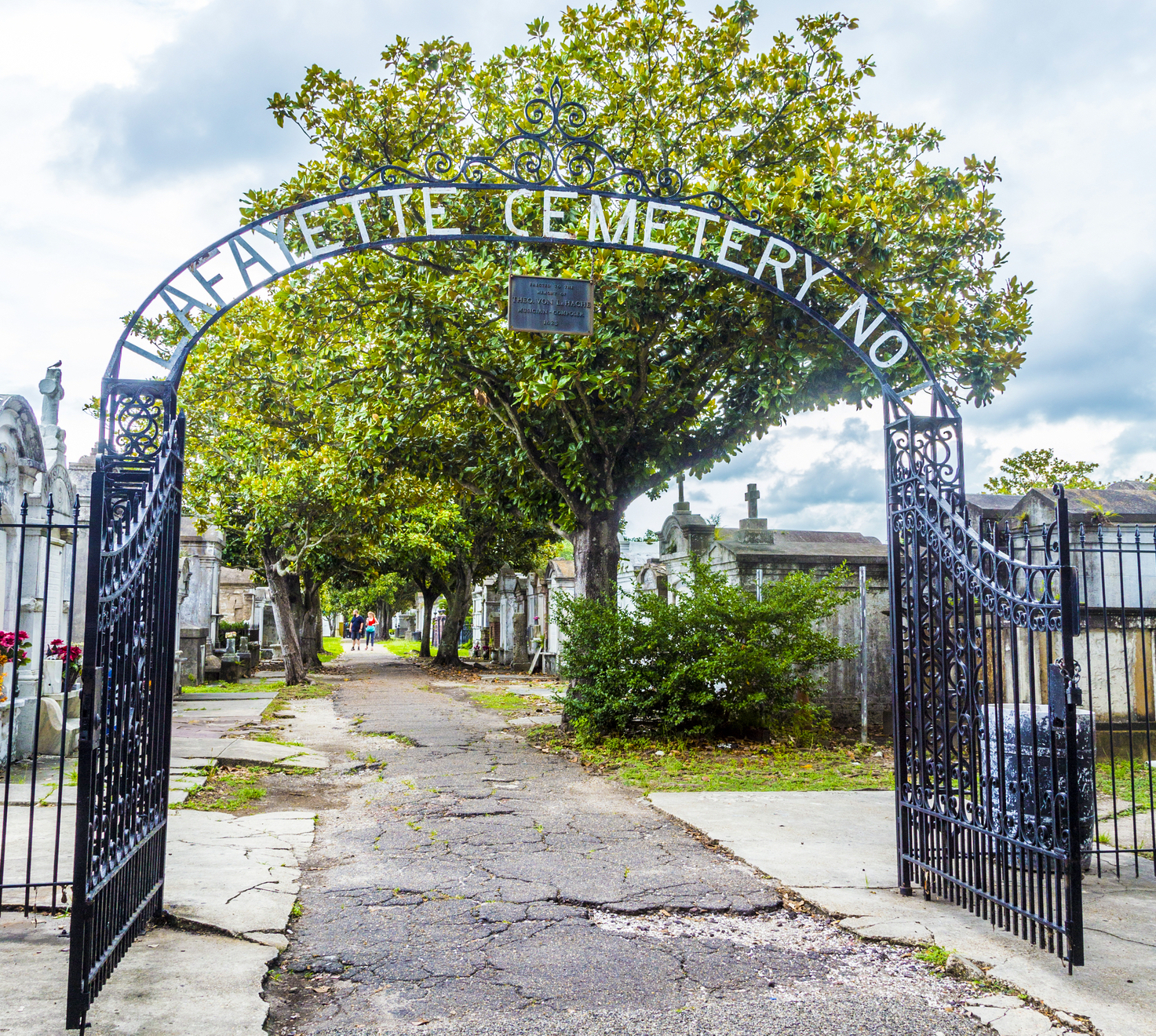
PHOTO: Lafayette Cemetery No. 1, New Orleans, Louisiana. Photo by Colin Ross, used by permission. 

new orleans licensed mein zahn

NOTE FROM THE AUTHOR: “New Orleans” was inspired by a trip to New Orleans a few years ago, particularly the tour I took of Lafayette Cemetery No. 1 and by our fortuitously coming across a repast outside a funeral home.

PHOTO: Entrance to Lafayette Cemetery No. 1, New Orleans, Louisiana. Photo by Mein Zahn, used by permission. 

Country_201407126765_Anne copy

ABOUT THE AUTHOR: Anne Whitehouse is the author of seven poetry collections, most recently Outside from the Insidejust out from Dos Madres Press, as well as a novel, Fall Love.

Via Lactea by Robert Lima

pacheco photograph 1

Via Lactea
On the Photograph by Dionisio Ameal Pacheco
by Robert Lima

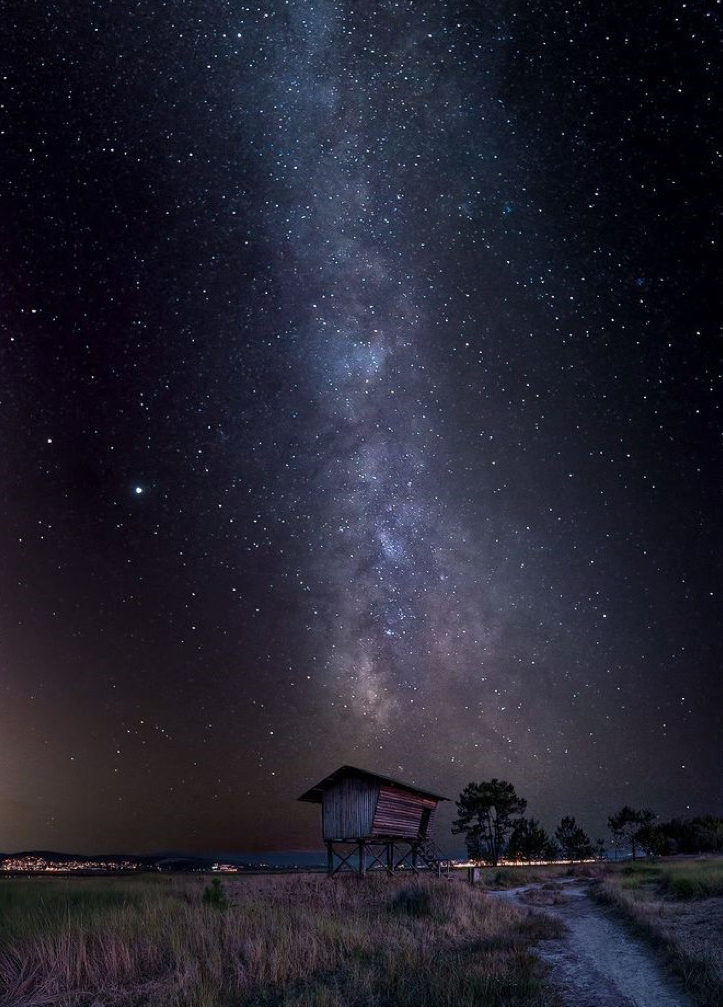
The old hórreo, a granary on the Rio Minho,
receives the torrent of stars into its wooden hold.
It is a stellar blessing on the landscape
of the ancient Celtic peoples,
sons of Breogán, that begat the line.

A bountiful engagement of primal matter
and elemental Earth,
the stars falling on Galicia,
melded in the deep hold of the hórreo.

PHOTO: “Via Lactea” (Milky Way) Galicia, Spain, by Dionisio Ameal Pacheco, used by permission. 

NOTE: Galicia is an autonomous community and historic region of Spain, bordered by the Atlantic Ocean to the north and west and by Portugal to the south. The autonomous community of Galicia was established on April 6, 1981. Galicia has a parliament, headed by a president, and a unicameral assembly. The capital is Santiago de Compostela, which was designated a UNESCO World Heritage site in 1985. 

robert lima

ROBERT LIMA, is a Cuban-born award-winning poet, and an internationally recognized critic, bibliographer, playwright, and translator. As a Greenwich Village poet during the 1960s, he read at coffeehouses and other venues, co-edited Seventh Street: Poems of Les Deux Megots, introduced by Denise Levertov, and the second series of Judson Review. His 15 poetry collections include Celestials, Elementals, Sardinia/Sardegna, Ikons of the Past. Poetry of the Hispanic Americas and Writers on My Watch (2020). Over 600 of his poems have appeared in print in the U.S. and abroad. Eleven of his poems have just appeared in Greek translation in Noima Magazine. Among his numerous critical studies are works on García Lorca, Valle-Inclán, Borges, Surrealism, folklore, dramatic literature, and translations of plays and poetry.

Père Lachaise by Jennifer Lagier

chopin-503227_1920

Père Lachaise
by Jennifer Lagier

Our guide, Jean-Jacques,
tells us stories,
reads inscriptions
on mausoleums.
Marks a map as I
explore a city of death
with expatriate friends.
We pass grandiose memorials.
Angels and antichrists decompose
beside housewives and saints.
Fading lipstick kisses polka dot
Oscar Wilde’s neutered sphinx.
According to rumor, a bureaucrat
anchors his paperwork with
the severed stone sex.
Someone has stolen Jim Morrison’s
bronze bust, a poppy and twist
of marijuana left in its place.
Gertrude Stein holds her final soiree
among deceased literati.
Effigies of the Buchenwald slaughtered
hold hands and dance.

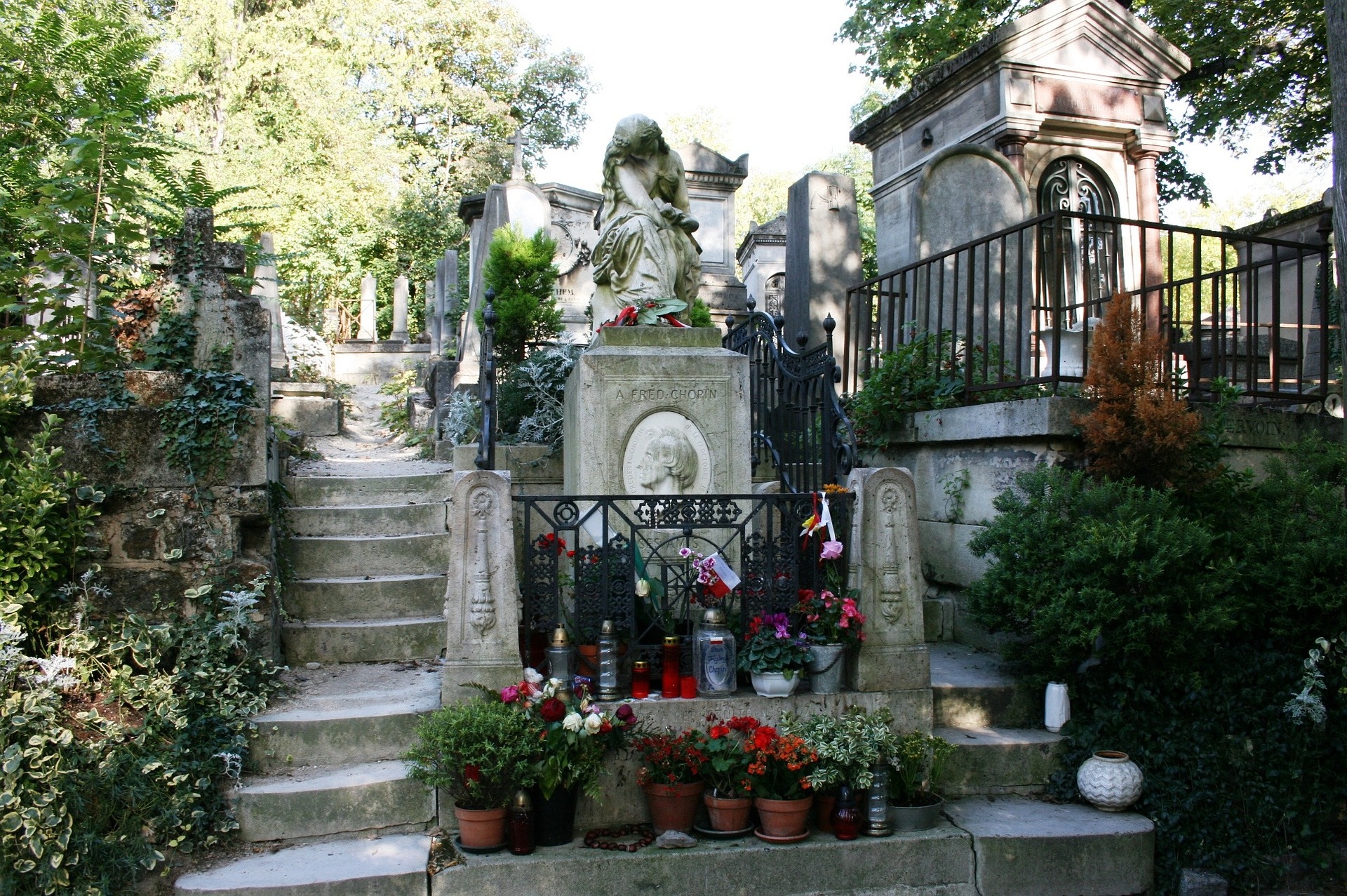
PHOTO: Père Lachaise Cemetery, Paris, France, showing the grave of composer Frédéric  Chopin (1810-1849). Photo by Pixabay, used by permission. 

paris-920155_1920

NOTE: Père Lachaise Cemetery, the largest cemetery in Paris, France, is visited by more than 3.5 million people each year. Established as a cemetery by Napoleon in 1804, it is named for the confessor to Louis XIVPère François de la Chaise (1624–1709).  Père Lachaise is still an operating cemetery, but will only accommodate individuals who die in Paris or have lived there. Many renowned people are buried in Père Lachaise. 

PHOTO:  Père Lachaise Cemetery by Coco Parisienne, used by permission. 

jen-20161ABOUT THE AUTHOR: Jennifer Lagier has published eighteen books. Her work appears in From Everywhere a Little: A Migration Anthology, Fire and Rain: Ecopoetry of California, Missing Persons: Reflections on Dementia, Silent Screams: Poetic Journeys Through Addiction & Recovery. Her newest book is Camille Comes Unglued (Cyberwit). Forthcoming is Meditations on Seascapes and Cypress (Blue Light Press). Visit her at jlagier.net.
Pont Alexandre III by Beverly M. Collins

seine-river-985613_1920

Pont Alexandre III 
by Beverly M. Collins

An ageless ornament adorns the
hand of flow

The past and future kiss a nymph
arch in the middle that slide
to the shining bend of winged
horses that kick on both sides

Upon narrow thin-ness stands
Copper’s pull on the push of gold.
distinguished gold’s steady gaze
sternly fixed on copper’s mischief.

As both silently envy the free,
determine and playful babble
of water that moves below them.
A meek ripple bashful in sound
and bold in its colorful history.

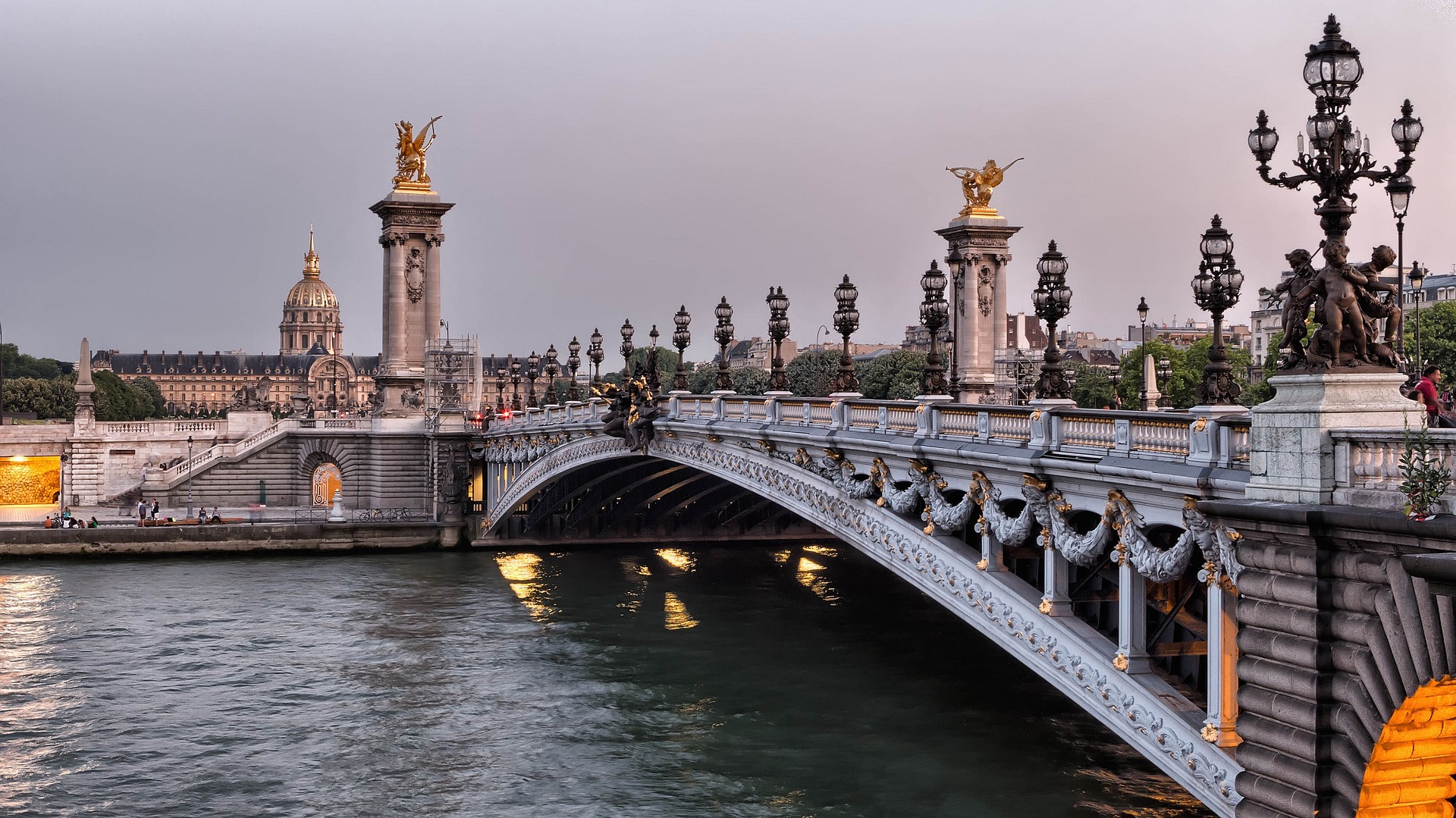
PHOTO: Pont Alexandre III, Paris, France. Photo by Skeeze, used by permission.

pont-alexandre-iii-187925_1920

NOTE: The Pont Alexandre III is a deck arch bridge that spans the River Seine in Paris, France. The Beaux-Arts style bridge, with its Art Nouveau lamps, cherubs, nymphs and winged horses at either end, was built between 1896 and 1900. It is named after Tsar Alexander III, who had concluded the Franco-Russian Alliance in 1892. His son Nicholas II laid the foundation stone in October 1896. Designed by architects Joseph Cassien-Bernard and Gaston Cousin, it was inaugurated in 1900 for the Exposition Universelle (universal exhibition) World’s Fair.

PHOTO: Pont Alexandre III place marker. Photo by David Mark.

collins 1

ABOUT THE AUTHOR: Beverly M. Collins is the author of Quiet Observations: Diary thought, Whimsy and Rhyme and Mud in Magic. Her work has also appeared in California Quarterly, Poetry Speaks! A year of Great Poems and Poets, The Hidden and The Divine Female Voices in Ireland, The Journal of Modern Poetry, Spectrum, The Altadena Poetry Review, Lummox, The Galway Review (Ireland), Verse of Silence (New Delhi), Merak Magazine (London), Scarlet Leaf Review (Canada), The Wild Word Magazine (Berlin), Indigomania (Australia) and many others.  She is the winner of a 2019 Naji Naaman Literary Prize in Creativity (from Lebanon). Collins is also a prize winner for the California State Poetry Society and has been twice nominated for the Pushcart Prize, once for Independent Best American Poetry and short-listed for the 2018 Pangolin Review Poetry Prize (Mauritius).