Off the Highway by Julia Weld Huntington

Wisconsin licensed Hannah Babiak

Off the Highway
by Julia Weld Huntington

Lilacs lift leaves of cool satin
And blossoms of mother-of-pearl
Against the tarnished silver of the deserted house.
Tall, exquisite grasses fill the dooryard with spray.
Through the sun-drenched fragrance drifts the hazy monotone of bees
Tints of opal and jade; the hush of emerald shadows,
And a sense of the past as a living presence
Distill a haunting wistful peace.

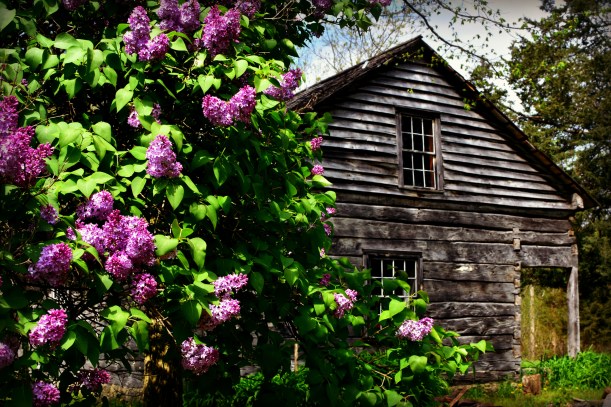
PHOTO: Lilacs blooming by the Norwegian House at Old World Wisconsin — a living history museum. Photo by Hannah Babiak, used by permission.

Route 684, Southbound Rest Stop by Jessica Greenbaum

Mother and daughters hold hands on sunset in the forest

Route 684, Southbound Rest Stop
by Jessica Greenbaum

So you see why it could not have been a more humble moment.
If there was any outward sign of regalia
It might have been the twilight crowning of the day, just then,
A perfect moment of dusk, but changing, as a wave does
Even as you admire it. Because the southbound stop
Mirrors the one northbound where we so often find ourselves
At the beginning, southbound’s return holds the memory
Of northbound’s setting-out, and the grassy median between
With its undisturbed trees defines an elusive strip of the present
Where no one lives. After twenty-eight years of the trip,
It’s like two beakers of colored water — one green, one blue —
Have poured themselves back and forth, because
On one side we are tinted by remembering the other.
But this aspect of the journey, at least, we know we will repeat.
As dusk cohered that moment — aquas, pinks, violets —
Just at that moment as I was returning to the car
A woman came the other way, her two young daughters
Holding her hands, and the gloaming sparkled around them
So that I froze, as they were backlit, starry,
They were the southbound reminder of who I had been beginning
The trip. She didn’t look like me, but what I did recognize
Was her clarity of purpose, in what Sharon Olds called
the days of great usefulness, making life as nice
As she could for them, always writing the best story,
And also, beneath her skin, living with delight as quiet
As the shoots anchoring grass beneath the earth.
I walked back to my car. My husband sat in the driver’s seat,
Our weekend’s luggage thrown in back.
Tell me we really had those girls, I said,
and that they held my hands like that. When I got home
I pictured her helping them each into bed — I knew it was
Later than she had hoped — then reading
Each section of the paper’s terrible news, finally alone.

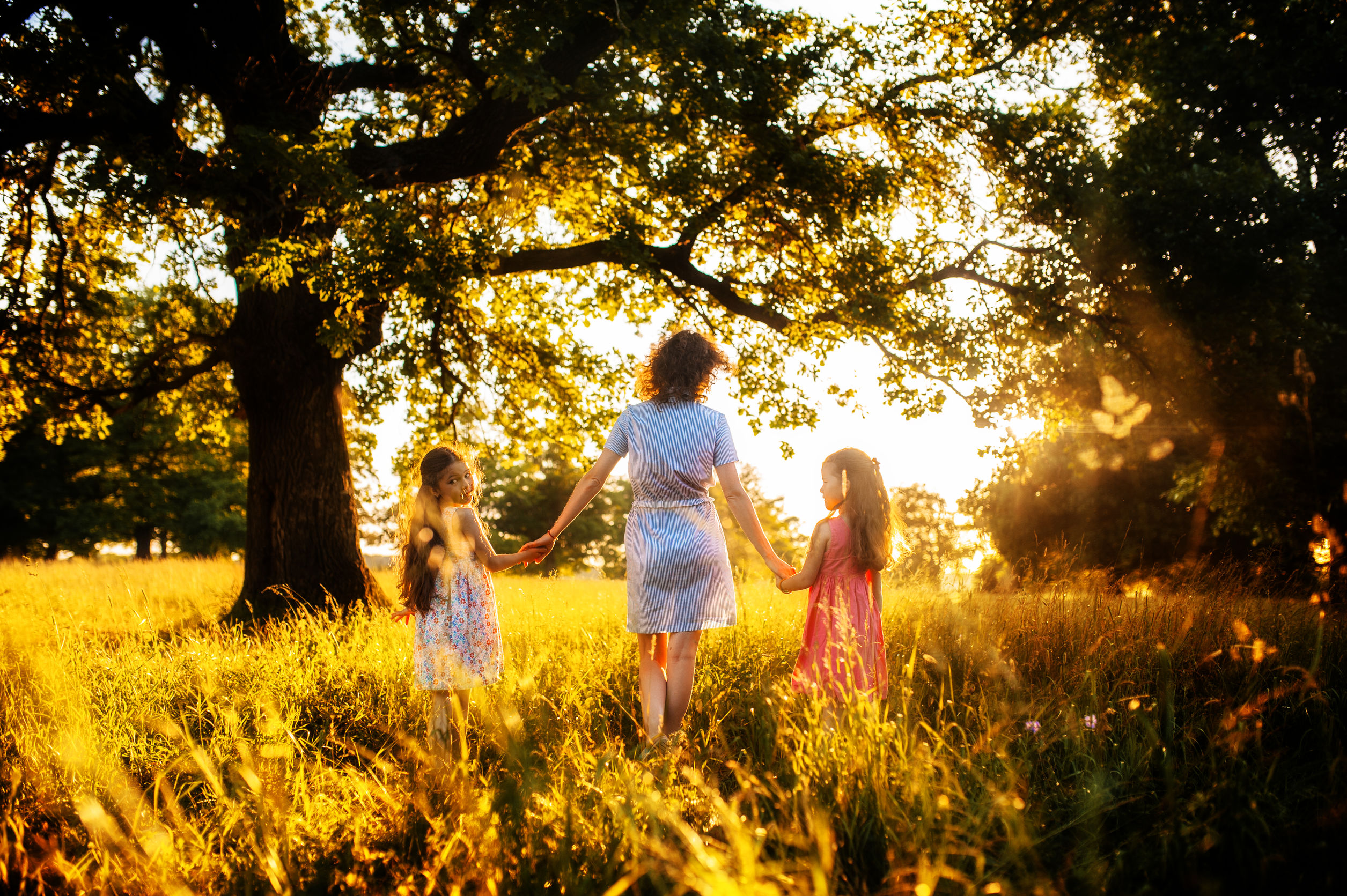
PHOTO: Mother and daughters, sunset in the forest. Photo by Anna, used by permission. 

All my rains by Rose Mary Boehm

caribbean licensed hopsalka

All my rains
by Rose Mary Boehm

I
Warm rain in the Caribbean,
giant bathtub abruptly
turned over by a tropical giant.
Rain that hurts. Rain that washes
away topsoil, flattening crab claw,
golden trumpet and scorpion orchid,
leaving the waxrose gasping for air,
fills all dents in the hotel patios.
Tennis courts become square lakes
of reddish, sandy mud. Every passing
car’s a drencher. Take off your sandals.
Let your feet transmit the moment
when a god created water and land.
A stifling thirty-eight degrees in the shade,
sabotaged for a brief, exulted moment,
soon reclaims its protagonism.

II
A dry spell on the Castilian plateau. Earth
crust breaks like freshly baked bread. All greens
from spring and early summer dusted ashen
by hot winds. The sky turns a metallic grey,
eucalyptus whisper urgent messages to
the poplars who bow in acquiescence.
Fat drops explode on the patio roof, cut through the
pines, leave welts on the soil. Soon the rains break.
Petrichor from wounded earth.

III
Squishing from the soggy wooden terrace
to the overflowing frog pond. Grasses bend
under the weight of the constant drizzle
of an English summer. Brushing past the dripping
hollyhock, it shakes its droplets onto my hair.
Peony’s heads hang low and heavy, the song thrush
shelters in the blackthorn. The shed’s rusted
door hinges whine. From my poisonous-orange
slicker dried earth from last year is washing off.
Into sudden silence the song thrush trills
an acknowledgement of a forgotten afternoon sun.

IV
A small fishing village in the north of France.
Night and rain fall on roofs and streets, boots slip
through pools growing in importance between broken
asphalt and smooth cobblestones, the old
buildings hiding behind curtains of cold water.
We were caught by surprise on the way back
to the hotel, a couple of lonely figures hesitating where
streetlights seemed to transform puddles into lakes.

V
It never rains in Lima’s coastal desert. Humidity
ranges from 85 to 95 percent. Despite the lack
of water falling from the skies we may
well develop gills. In our wardrobes
mushrooms grow on shoes.

PERU BOEHM

NOTE FROM THE AUTHOR: Since I have lived in so many places, now—towards the last part of my life—I am beginning to recollect where I’ve been and what impressed me most. Often it’s people who tie you to a place, sometimes its actual beauty. But one of the things I remember are the rains. I tried to express this in my poem.

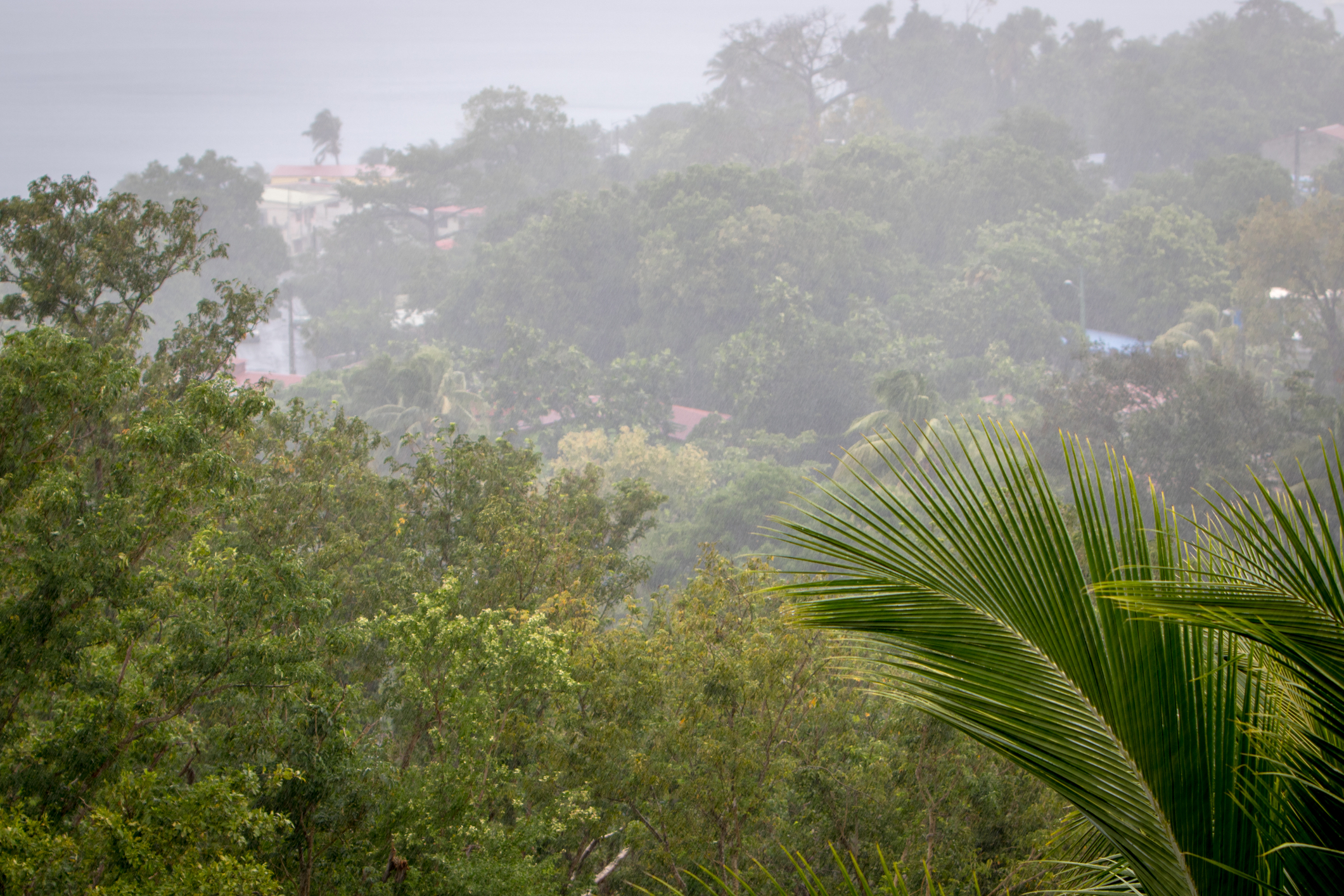
AUTHOR’S PHOTO CAPTION: The sky over Lima, Peru, that promises rain but hardly ever delivers. Photo by the author.

rose-m-boehm

ABOUT THE AUTHOR: Rose Mary Boehm is a German-born British national living and working in Lima, Peru. Her poetry has been published widely in mostly US poetry reviews (online and print). Her fourth poetry collection, The Rain Girl, was published by Chaffinch Press in August 2020.

Rain by Frances Shaw

lake-3811920_1920

Rain
by Frances Shaw

When in the night the storm rises,
I will run before it
To the long shore,
And there await the arms
Slanting toward me—
The strong gray arms of the rain.
And I will lean on them,
And be enchanted,
And whispered to
By the soft insistent voice
Of the rain.

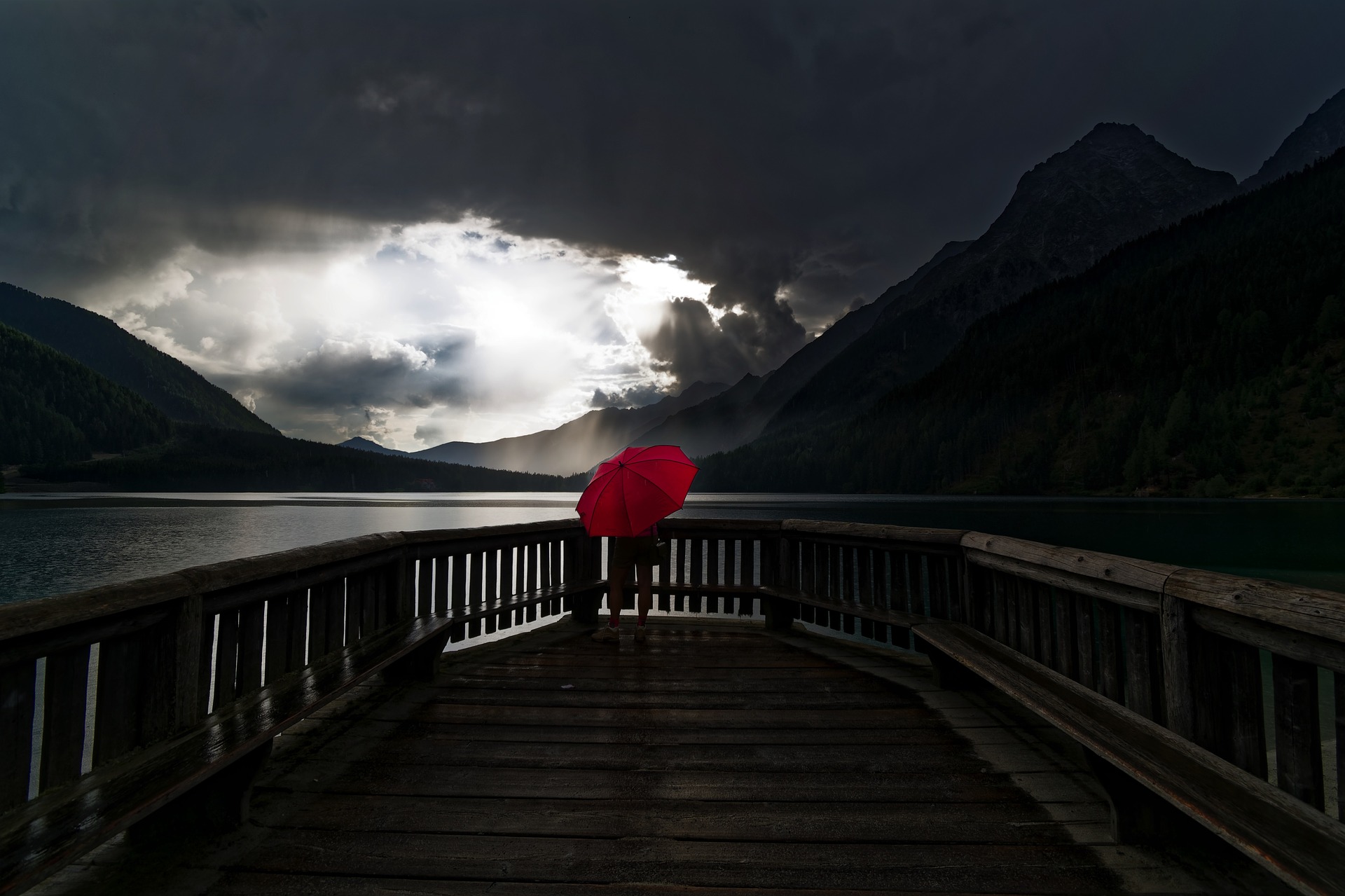
PHOTO: Lake Anterselva, South Tyrol, Italy, by Giampaolo Mastro, used by permission.

Rain in the Hills by William Haskell Simpson

Rain in the Hills
by William Haskell Simpson

Were I the rain
Coming over the hills—

I should be glad
That my cool fingers could ease the little fevers of dusty
     water-holes,
And caress curled leaves of the cottonwoods.

The herd,
Pawing, bellowing, would let me quiet them,
Standing in fresh pools by dusty water-holes–

If I were the rain
Coming over the hills.

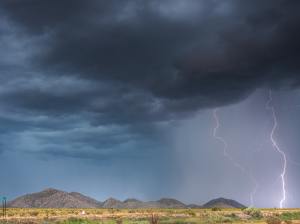
PHOTO: Thunderstorm in the hills near Santa Fe, New Mexico. Photo by Raychel Sanner on Unsplash

Streets in Shanghai by Tomas Tranströmer

shanghai licensed songquan deng

Streets in Shanghai
by Tomas Tranströmer
Translated by Patty Crane

1
The white butterfly in the park is being read by many.
I love that cabbage-moth as if it were a fluttering corner of truth itself!

At dawn the running crowds set our quiet planet in motion.
Then the park fills with people. To each one, eight faces polished like jade, for all
situations, to avoid making mistakes.
To each one, there’s also the invisible face reflecting “something you don’t talk about.”
Something that appears in tired moments and is as rank as a gulp of viper schnapps with its long scaly aftertaste.

The carp in the pond move continuously, swimming while they sleep, setting an example for the faithful: always in motion.

2
It’s midday. Laundry flutters in the gray sea-wind high over the cyclists
who arrive in dense schools. Notice the labrinths on each side!

I’m surrounded by written characters that I can’t interpret, I’m illiterate through and through.
But I’ve paid what I owe and have receipts for everything.
I’ve accumulated so many illegible receipts.
I’m an old tree with withered leaves that hang on and can’t fall to the ground.

And a gust from the sea gets all these receipts rustling.

3
At dawn the trampling hordes set our quiet planet in motion.
We’re all aboard the street, and it’s as crammed as the deck of a ferry.

Where are we headed? Are there enough teacups? We should consider ourselves lucky
to have made it aboard this street!
It’s a thousand years before the birth of claustrophobia.

Hovering behind each of us who walks here is a cross that wants to catch up with us,
pass us, unite with us.
Something that wants to sneak up on us from behind, put its hands over our eyes and
whisper “Guess who!”

We look almost happy out in the sun, while we bleed to death from wounds we don’t
know about.

PHOTO: Nanjing Road In Shanghai, China (May 2012)—the road extends about four miles, making it the world s longest shopping district, with 1M visitors daily. Photo by Songquan Deng, used by permission. 

NOTE: Shanghai is one of the four direct-administered municipalities of the People’s Republic of China. With a population of 24.28 million as of 2019, it is the most populous urban area in China and the second most populous city in the world. Shanghai is a global center for finance, technology, innovation, and transportation, and the Port of Shanghai is the world’s busiest container port.

Often I Imagine the Earth by Dan Gerber

jian 3a copy1 copya

Often I Imagine the Earth
by Dan Gerber

Often I imagine the earth
through the eyes of the atoms we’re made of—
atoms, peculiar
atoms everywhere—
no me, no you, no opinions,
no beginning, no middle, no end,
soaring together like those
ancient Chinese birds
hatched miraculously with only one wing,
helping each other fly home.

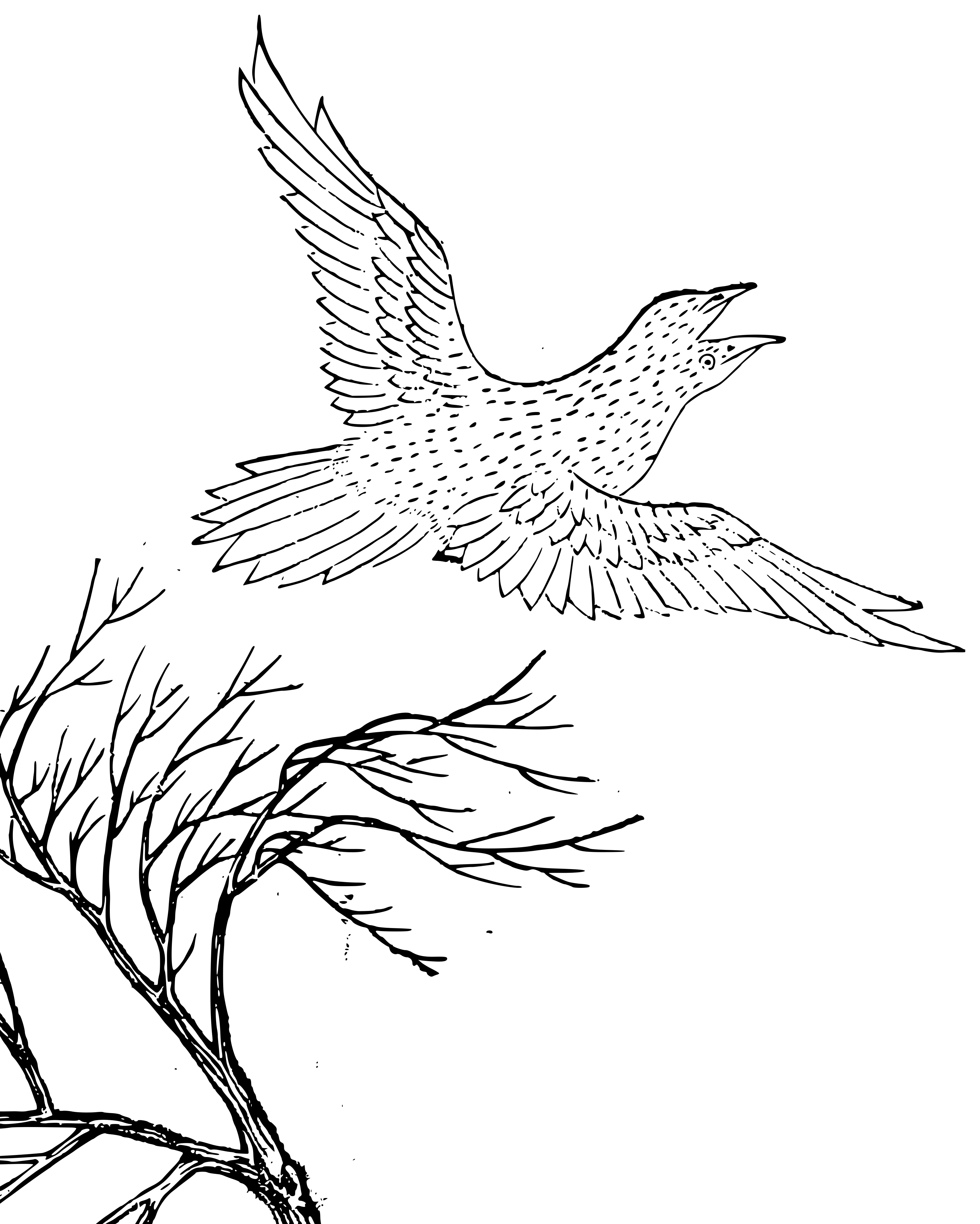
IMAGE: “Jian birds” from Sancai Tuhui, an encyclopedia compiled by Wang Qi and his son Wang Siyi, completed in 1607 and published in 1609 during the Ming dynasty, featuring illustrations of subjects in the three worlds of heaven, earth, and humanity.

NOTE: The Jian, also known as birds that fly together, are mythical birds that possess only one eye and one wing. These creatures are born imperfect, and need to lean against each other and act as one in order to fly. Their mutual dependence is eternal, lasting through death and rebirth.

Midnight and Thirty-Two Maharajahs Jodhpur, Rajasthan, India by Graham Wood

hotel 1

Midnight and Thirty-Two Maharajahs
Jodhpur, Rajasthan, India
by Graham Wood
     For Rosemary

Midnight, and thirty-two maharajahs
look down from the family pedigree,
corralled above you while you sleep.
On the mantel, a clock ticks in quiet
syncopation with your breathing—
tomorrow and our departure edge
their way towards the dawn.
Here, this night
you’ve notched up fifty years
serene in sleep below these royal ghosts,
oblivious of their chequered past.
Thirty-two maharajahs above your head
and your father met the second last!
Tonight beside you in this king-sized bed
I gauge my wealth above these kings—
I’d give my weight in gold for you.

© Graham Wood

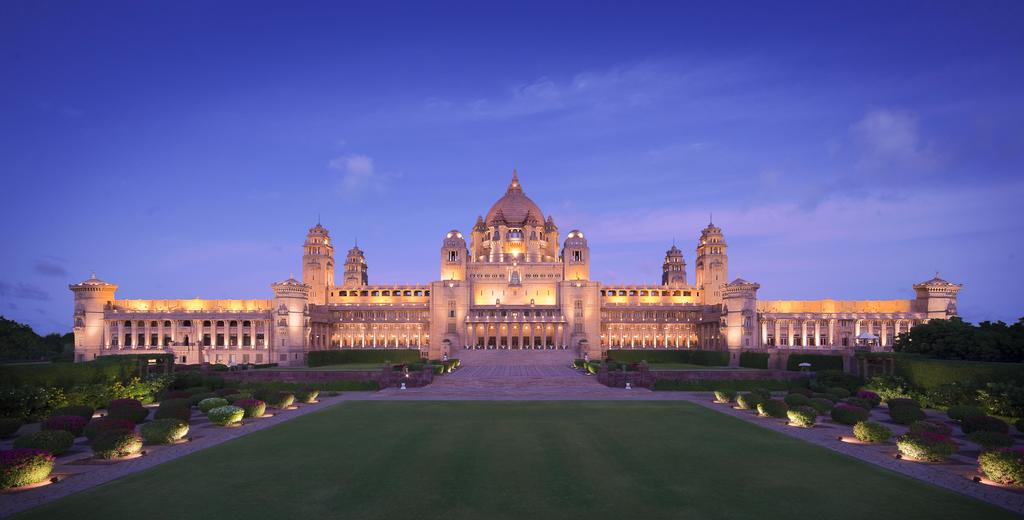
PHOTO: View of the Umaid Bhawan Palace. 

AUTHOR’S NOTE REGARDING PREVIOUS PUBLICATION: This poem was previously published in the annual anthology fourW fifteen (2004), a collection of poetry and prose by Wagga Wagga Writers Writers (hence four Ws!), Booranga Writers Centre at Charles Sturt University, NSW, Australia.

hotel 3

NOTE FROM THE AUTHOR: The poem was written for my partner Rosemary during a trip to Jodhpur in Rajasthan, where we stayed in a grand hotel previously the Maharajah’s palace — the Umaid Bhawan Palace Hotel. We were there to see where her father, a pilot in the Royal Air Force, had been billeted during World War II in the grounds of the palace itself. During the conflict, the RAF contingent had been ferrying planes and supplies across India to the Burmese border. While we were there, we also celebrated a significant birthday for Rosemary. The end of the poem reflects a certain historical quirk of some more distant maharajahs: on certain high ceremonial occasions they would weigh themselves in public and distribute an equivalent weight of gold and jewels among their subjects. The last line, of course, is also a play on the old saying about someone beingworth their weight in gold.”

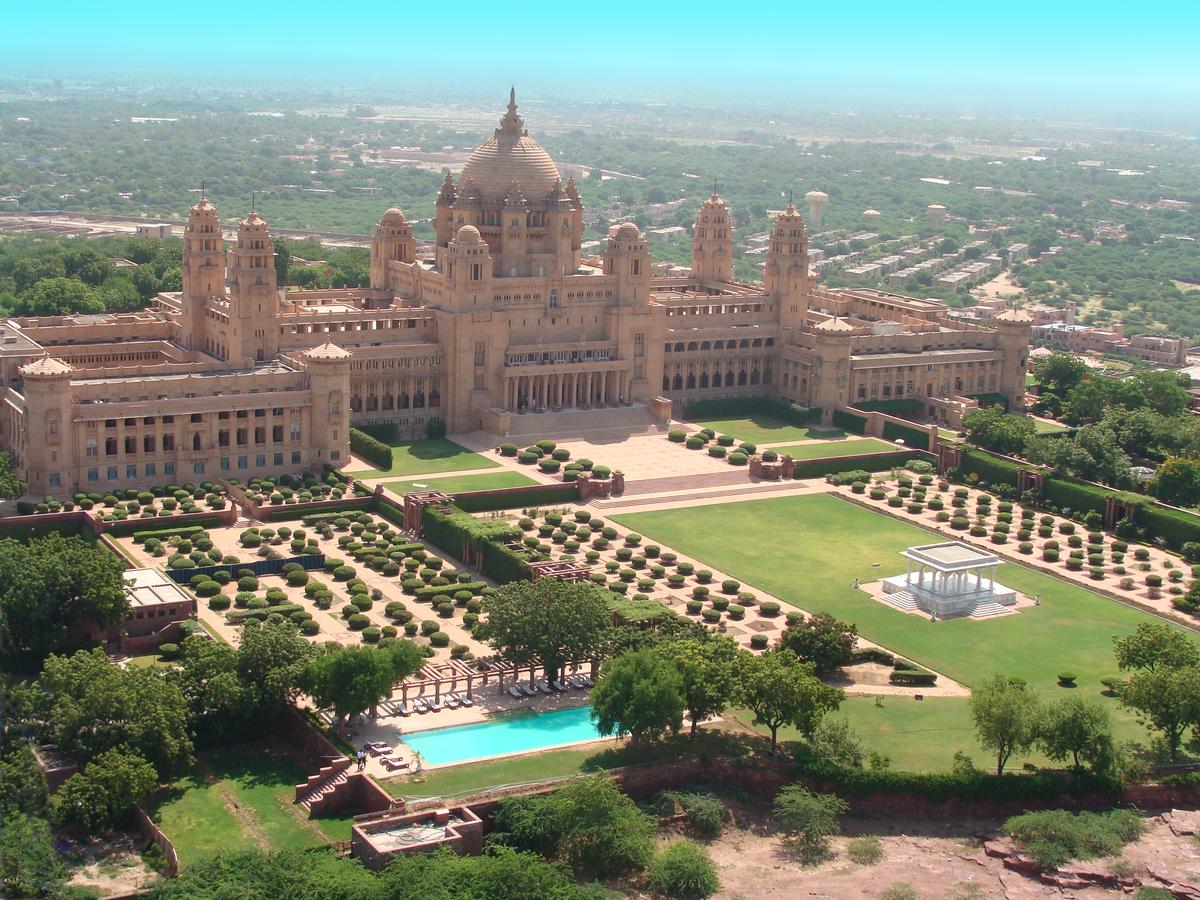
NOTE: Umaid Bhawan Palace, located in Jodhpur in Rajasthan, northwestern India, is one of the world’s largest private residences. Named after Maharaja Umaid Singh, grandfather of the present owner Gaj Singh, the palace has 347 rooms and is the principal residence of the former Jodhpur royal family. A part of the palace is a museum. Ground for the foundations of the building was broken on November 18, 1929 by Maharaja Umaid Singh and the construction work completed in 1943. Recently, Umaid Bhawan Palace was awarded as the World’s best hotel at the Traveller’s Choice Award, organized by TripAdvisor.

PHOTO: Aerial view of Umaid Bhawan Palace and grounds. 

Graham Wood Photo

ABOUT THE AUTHOR: Graham Wood lives in the northern suburbs of Sydney, New South Wales, Australia, and has worked in a variety of occupations. These include high school teacher, film classifier, and public servant, the latter mainly in the field of higher education policy and planning. His poems have been published in a range of Australian and international journals and anthologies, including Westerly, fourW, and The Sydney Morning Herald in Australia, and Silver Birch Press and Vita Brevis Press in the USA. He is a member of the North Shore Poetry Project in Sydney.

The Jain Bird Hospital in Delhi by William Meredith

bird hospital india delhi

The Jain Bird Hospital in Delhi
by William Meredith

Outside the hotel window, unenlightened pigeons
weave and dive like Stukas on their prey,
apparently some tiny insect brother.
(In India, the attainment of nonviolence
is considered a proper goal for human beings.)
If one of the pigeons should fly into the illusion

of my window and survive (the body is no illusion
when it’s hurt) he could be taken across town to the bird
hospital where Jains, skilled medical men,
repair the feathery sick and broken victims.
There, in reproof of violence
and of nothing else, live Mahavira’s brothers and sisters.

To this small, gentle order of monks and nuns
it is bright Vishnu and dark Shiva who are illusion.
They trust in faith, cognition, and nonviolence
to release them from rebirth. They think that birds
and animals—like us, some predators, some prey—
should be ministered to no less than men and women.

The Jains who deal with creatures (and with laymen)
wear white, while their more enterprising hermit brothers
walk naked and are called the sky-clad. Jains pray
to no deity, human kindness being their sole illusion.
Mahavira and those twenty-three other airy creatures
who turned to saints with him, preached the doctrine of ahimsa,

which in our belligerent tongue becomes nonviolence.
It’s not a doctrine congenial to snarers and poultrymen,
who every day bring to market maimed pheasants.
Numbers of these are brought in by the Jain brothers
and brought, to grow back wing-tips and illusions,
to one of the hospitals succoring such small quarry.

When strong and feathered again, the lucky victims
get reborn on Sunday mornings to the world’s violence,
released from the roofs of these temples to illusion.
It is hard for a westerner to speak about men and women
like these, who call the birds of the air brothers.
We recall the embarrassed fanfare for Francis and his flock.

We’re poor forked sky-clad things ourselves
and God knows prey to illusion—e.g., I claim these brothers
and sisters in India, stemming a little violence, among birds.

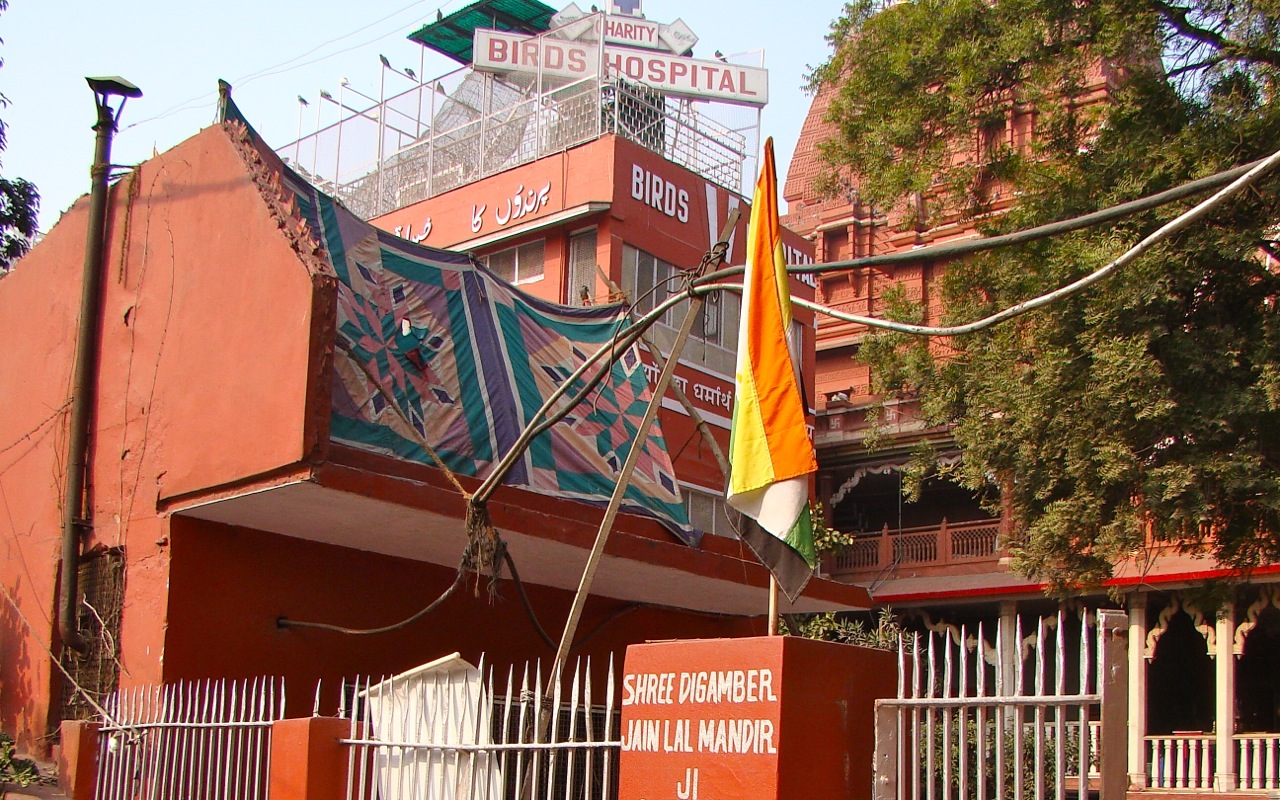
PHOTO: Jain Birds Hospital, Delhi, India. Read more about Jainism here

VIDEO: Watch an inspiring video about the Jain Birds Hospital here. 

Digambar_Jain_Lal_Mandir,_Chandni_Chowk,_Delhi

NOTE: Shri Digambar Jain Lal Mandir is the oldest and best-known Jain temple in Delhi, India.  The temple is known for an avian veterinary hospital, called the Jain Birds Hospital, in a second building behind the main temple. The temple is believed to have been built in 1656. 

PHOTO: Digambar Jain Lal Mandir, Chandni Chowk, Delhi. Also seen is the white Gauri Shankar hindu temple in the background. Photo by Art Poskanzer (2008).